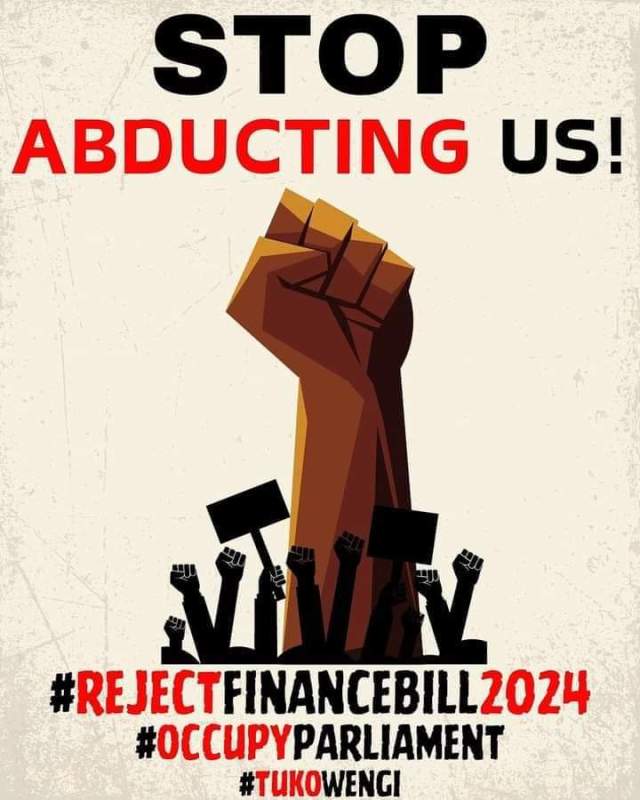
As the third round of anti-Finance Bill 2024 rallies begins on Tuesday, a conflict between the public and security officials looms.
The projected epicenter of the youth-led protests, the Nairobi Central Business District (CBD), was found to have a significant police presence, as confirmed by a spot check.
Security personnel have been stationed on a number of city center streets, with public access to the regions leading to Parliament being restricted.
The protests, spearheaded by young people, started last week as a protest against the vile Bill that would impose high taxes on Kenyans.
In protest of the Finance Bill, the demonstrators have promised to completely shut down business today.
The government attempted to back down, but the demonstrators insisted that they wanted the Bill repealed in its entirety, not just amended. There have reportedly been two fatalities.
Amidst mounting tensions, Interior Cabinet Secretary Kithure Kindiki clarified on Monday that the planned statewide protest can proceed as long as it remains peaceful.
He noted that as long as people follow the law, they are free to carry out their intentions to demonstrate.
Kindiki defied demonstrators to disrupt the peace, saying they “must not interfere with road, rail, sea, or air transport in any manner whatsoever.”
The latter, however, involves the kidnapping of people who are reportedly the most vocal about the protests, sparking outrage from the public as many Kenyans call for their immediate release.
During the protests last week, several youths were injured and two of them died.
Kenyans on the internet are protesting the rising number of activists and demonstrators being kidnapped by the police for being loud opponents of the contentious Finance Bill 2024.
Social media posts circulated before the Tuesday’s planned nationwide rallies against the proposed law, claiming that prominent participants in the youth-led nonviolent protests had been detained and their locations were unknown.
Among them is Gabriel Oguda, a well-known social critic and outspoken opponent of President William Ruto’s administration, who was reportedly kidnapped early on Tuesday morning.
Zachary, Oguda’s brother, said on the web that the newspaper writer was picked up by individuals he thought were police and taken from his home.
“Any tweets coming from @gabrieloguda were already scheduled. HE ISN’T SAFE,” Zachary added in a post some minutes past 4 a.m.
Other people behind the X pages include Franje, Drey Mwangi, and Osama Otero, among others.
The most recent incidents join the list of demonstrators detained over the weekend, including Shadrak Kiprono, also known as Shad Khalif, who was kidnapped on Saturday night in Nairobi’s South B neighborhood.
Following a public outcry, a few protestors were freed; on Sunday night, Dr. Austin Omondi, also known as Ja Prado, was set free.
Omondi was allegedly apprehended by people in a car with the license plate KCU 819H when he was conducting a blood drive for injured demonstrators at the Sikh Union on Nairobi’s Forest Road.
Billy Simani, commonly referred to as Crazy Nairobian, on X. He was arrested on Friday and was freed from police custody on Saturday night.
The Law Society of Kenya (LSK) and the Kenya Human Rights Commission (KHRC) have denounced the kidnappings and demanded an abrupt end to this trend.
“The abductions, often occurring at night and carried out by police officers in plain clothes and unmarked vehicles, aim to intimidate protesters planning to participate in future peaceful demonstrations urging MPs to reject the bill,” The KHRC stated on Monday.
LSK also demanded the abductees’ unconditional and immediate release.
A File Image of motorists stuck in traffic on a section of Mombasa Road
On social media Tuesday morning, drivers on Mombasa Road bemoaned a severe congestion.
Our correspondent observed a traffic build-up from Athi River, Kitengela, Mlolongo towards Nairobi during a spot check.
One driver stated on social media, “As you head towards the CBD, there is a road block at Mlolongo.”
The rather dense police presence on the busy highway coincides with the anticipated arrival of demonstrators in Nairobi’s streets.
“Police officers put up road blocks early Tuesday morning. I spotted several road blocks as early as 5 a.m.,” another added.
There will be youth protests against the Finance Bill 2024, with participants expected to come from around the nation.
The police will maintain their neutrality while being stern, Kenyans were reassured earlier by Interior Cabinet Secretary Kithure Kindiki.
“The National security organs of our country shall remain neutral, apolitical but firm in enforcing the law of our country and no form of lawlessness is going to be entertained whatsoever.
Protesters ought to stop their much anticipated Tuesday demonstrations by sundown or 6.30 p.m., “whichever comes first,” according to Interior CS Kithure Kindiki.
Tuesday has been scheduled for nationwide anti-Finance Bill protests, which are largely organized by youths.
The CS stated in a press conference on Monday that participants in the protests must behave peacefully and without weapons.
“The protesters must stop their activities at sunset or at 6.30pm whichever is earlier in accordance with the Public Order Act (Cap 57),” he stated.
Kenyans, he continued, have the freedom to protest, but the law places restrictions on it.
“They must make sure that the enjoyment of these rights does not prejudice the rights and freedoms of others,” he said.
Kindiki issued the directive in response to the Thursday protests in Nairobi’s Central Business District that continued late into the night.
Along with chanting and dancing to music from bluetooth speakers and nightclubs on Moi Avenue, protesters held placards and started bonfires in the street.
After the Finance Bill reached the second reading stage with 204 MPs voting in favor of it and 115 against it, the protestors became enraged.
Shortly after Members of Parliament enacted the Finance Bill, 2024, irate youths stoned cars at Parliament Buildings.
Some members of the Parliamentary staff hurriedly drove their vehicles into basement parking to avoid the demonstrators’ wrath after being taken off guard and having to scramble for safety.
The National Police Service promptly declared in a statement that it would not permit protestors to interfere with parliamentary processes or take control of key government buildings.
Inspector General of Police Japhet Koome signed a statement stating that while NPS respects Article 37 of the Constitution, which guarantees citizens’ freedom to congregate, demonstrate, and picket, it would not tolerate attacks on government property.
One person died as a result of the demonstrations on Thursday night after he was allegedly shot and killed by a police officer.
Around seven o’clock at night, Rex Kanyike Masai, 29, was shot and died on Moi Avenue.
After being pushed by police from various locations, including portions of Kenyatta Avenue and City Hall Way, a number of protesters assembled outside Moi Avenue
They began to dance to music emanating from the on-site club.
Witnesses said that at that point, a police officer wearing a cap and regular clothes appeared and began shooting at the group in an attempt to disperse them.
Rex was struck in the leg and collapsed onto the road, wailing for help.
On Friday, June 21, a second victim passed away due to injuries he sustained during the demonstrations.
During the demonstrations, Evans Kiratu is said to have been hit in the groin with a tear gas canister.
A number of well-wishers drove Kiratu to Kenyatta National Hospital, where he received treatment for severe injuries and internal bleeding.
Hello followers. Welcome to another day of our CEREALS BUSINESS TRAINING.
In Kenya it is important to register your business. If you do not, you will face arrest by county government officials and prosecution in a court of law.
You will not be issued with a business license for your business unless it is duly registered.
Unless you are licensed, your business will not be allowed to operate, and it will be closed for failure to comply.
The digital age comes with a lot of benefits. The increasing introduction of online platforms continues to make work less tedious.
Consequently, conducting a name search and business registration in Kenya has been made a lot easier by online systems.
Long gone are the days when one had to do a manual business name search and registration.
Business registration in Kenya is an entity under the Registrar of Companies. The body is in charge of all registrations of a business or a company in Kenya.
Their primary role is to ensure that businesses and companies in Kenya are issued will all necessary certificates. However, the actual process of name searches and registration is via an online system, eCitizen.
All registered companies in Kenya go through a similar registration process, although the costs and requirements vary.
Companies that have already been incorporated outside Kenya can register as a branch or subsidiary of a foreign corporation. They will receive a certificate of compliance as proof that all the conditions have been met.
There are benefits of registering your business, these include but are not limited to:
Identity – Once you have registered your business, it acquires a unique identity. A business cannot share the same identity with another business.
Safety and security – Registering your business separates you (owner) from risks involved in doing business. This way, the business can attract more partners, investors and can even be insured.
Continuity – In the eventuality that the owner of the business dies, the business still lives on. One’s next of kin or partner can take over and continue with the business.
Growth – It is increasingly easier to grow your business once it is duly registered. With registration, you can have a bank account for your business, and this can enable you get access
to credit that can help you expand it. Registering will also help you to separate your personal income from that of the business.
Trust – Generally, clients/customers and suppliers easily develop trust for a business that they know has been registered in Kenya. Upon registration, your business is declared legal. Registration also makes it possible to have investors.
Kenyan citizens and foreigners are eligible to register a business in Kenya. This means it is possible for a refugee to register a business in Kenya and engage in income-generating activities.
Type of business can you register in Kenya
The most common types of businesses that can be registered are,
Sole proprietorship
This is a business that has one owner. You make all the decisions. As the owner, you are responsible for profits and losses in the business.
Partnership
A partnership is a business owned and run by two or more people who have a common view of making a profit that is shared.
Limited Liability Partnership (LLP)
LLPs are special business structures. It protects individual partners against the negligence of other partners in the business.
Company (Limited Liability)
1. Private company: Is mostly fully owned by the people who start it. Members of the public are not invited to buy shares or portions of the company. Funding is sourced privately by the founders or owners.
2. Public company: Is a company that has sold all or part of its business to the public in the form of shares. Such companies can raise funds through the sale of shares to the public. The buyers become shareholders and are eligible to share in the company profits and participate in decision-making.
CREATING AN ECITIZEN ACCOUNT
eCitizen is a platform that allows Kenyans to access government services such as renewal of driving license, application of passports, business registration service, etc.
Step 1
Gather your Kenyan ID and make an eCitizen account online. eCitizen is the online portal through which the Kenyan government conducts much of its official business.
It’s free to use and easy to sign up for. When creating a personal account, you will need to type in your Kenyan ID number (found on government-issued identification) and your name. Also enter a working email address.
*Start your eCitizen account online at: https://www.ecitizen.go.ke . Click on “Create an account” in the top-right corner.
*If you are a foreign citizen living in Kenya, you can use your Foreigner Certificate number instead of your Kenyan ID number.
*A Kenyan company can have directors who live abroad and are not Kenyan citizens. At least one of the director will have to be a Kenyan citizen, though, so that they can access eCitizen and submit certain forms.
Step 2
Upload a 5.5 cm × 5.5 cm (2.2 in × 2.2 in) passport photo. eCitizen requires you to upload a recognizable passport photo of yourself before registering your eCitizen account.
When the photo is being taken, maintain a neutral expression and look directly into the camera. Take off a hat or glasses if you are wearing a pair. Once you have a digital copy of the photo, upload it to the eCitizen portal to complete your profile.
The photo that you use needs to have been taken within 6 months of when you are registering your company.
Step 3
Navigate to the Business Registration Service home page. After creating your account, you can access the eCitizen online portal.
Visit the eCitizen home page, and you will see that there are 3 agencies that you can login to: the National Safety and Transport Authority, Business Registration Service, and Department of Immigration Services. Select the Business Registration Service.
This will redirect you to the home page for the Business Registration Service. This page can only be accessed once you have created an eCitizen account. Prior to making the account, you cannot link directly to the Business Registration Service page.
HOW TO REGISTER A SOLE PROPRIETORSHIP BUSINESS IN KENYA
Here are detailed steps to register a business that you fully own and control (Sole Proprietorship).
Step 1: Log in
Go to the Kenyan government citizen services portal https://www.ecitizen.go.ke and register for an account, or if you already have one, log in and go to the services section and click on “Business Registration Service”.
Step 2: Business Name registration
After completing Step 1 above, click on the “Make Application” button. Here you will be making an application for registering your business name.
In this section, you will indicate the Preferred name of your business, Nature of business, Registered office address, Ownership information, Application documents.
Your business name will be the identity of your business. It will take a maximum of 2 working days. This costs Ksh.150 and can be paid using mobile money, debit cards.
Upon completion of this step, a business name awaiting registration may be reserved for a maximum of 30 days. This period may be extended for 30 more days, where you will pay an amount like the initial application fee of Ksh.150. This will allow you more time (30 days) before you complete the business registration process.
In this step, ensure you meet the following requirements.
Preferred Name
Provide at least 3 preferred names in order of PRIORITY. The first available name will be automatically assigned to your business.
Nature of business
*Applicant’s details (Include full name as shown on your Identification Document or Passport),
*Capacity (Applying as the Proprietor or Lawyer- select proprietor if you are registering your own business)
*Address
*Postal code
*Application details (Select nature of business from the list available or choose ‘other’ if yours is not on the list.
Registered office address – Provide the details of where your business is located, as below:
*Primary address – county, district, locality
*Name of building, plot No./Estate and house no,
*Street/Road
*Postal address
*Postal code
*Mobile number (in this format +254xxxxxxxxx)
*Company Email address
Ownership information
Add proprietor: indicate names of persons starting the business. Use the “Add Proprietor” button for each person and provide the following details for each: (a) Kenya national identification card or passport number (b) PIN certificate number issued by the Kenya Revenue Authority (not applicable to the persons who is not Kenyan residents)
For foreigners legally living in Kenya, such as refugees, click on the ‘Foreign Resident’ option as illustrated below and add the personal details required for verification. If you have the correct registration details, the system will verify and automatically fill in your Date of Birth, Full Name, and Gender details.
Add your place of residence details, County, District, Locality, and actual place of residence.
Attach your passport photo and click ‘Submit’.
Application documents
Once you have provided and submitted all the necessary details in No.4 above, the system will automatically generate a ‘BN 2 Form’ Download the BN 2 Form, sign it and upload it back to the system.
Below is a sample BN 2 Form, showing where you should sign.
Step 3: Submission
Once you have met all the requirements in Steps 1 and 2 above, you will be required to pay for the registration fees of Ksh.950 on the website (eCitizen on business registration). It takes a maximum of 3-5 working days to have your application processed, however, the duration may vary depending on the number of applications.
Step 4: Certificate
The government of Kenya issues certification for all registered businesses. Once your registration application is approved, the certificate for your business will be available for
download on the eCitizen platform where you made the application. You can print it out and use your Kenya Revenue Authority (KRA) PIN certificate to get a bank account that you will be using for your business.
HOW TO REGISTER A COMPANY IN KENYA
Registering a company in Kenya was once a difficult and complicated process. Fortunately, in recent years, the Kenyan government has stepped in and streamlined the registration process.
Whether you’re a Kenyan citizen or a foreign business owner looking to open your business in Kenya, the process can still take the better part of a month—especially if your documents are not well organized—so begin the registration process well in advance of when you would like to start conducting business.
Step 1
Begin your application by choosing a business type. Once you are in the Business Registration Service, click on “Make Application.” On the next screen, click “Business Name Application.” From there, choose the type of business you would like to create.
There are 6 main types of business entities in Kenya. These are:
*Sole proprietorships
*Registered companies (public or private)
*Partnership
*Limited liability partnership
*A branch office of a foreign registered company
*Business societies
Step 2
Enter the name that you would like your business to have. In the indicated field, type in the business’s intended name (e.g., Sally`s Cereals Shop or Galgas Cereals Wholesalers).
The name may be rejected if it is too close to the name of an already-registered Kenyan business. You should hear back from the Registration Service within 2 business days regarding if the name is acceptable or not.
If the name is accepted, the registrar will reserve the name for 30 days. You have this much time to complete the business registration.
Step 3
Pay the Ksh.150 fee to file your name search. The Kenyan government requires potential business owners to pay a small fee to run the business-name search. You can pay online with a credit card. Enter your name and credit card number into the respective text boxes, and pay the fee to begin the name search.
The eCitizen site does not notify you via email once the name has been approved. So, you will need to log back in to your account on a daily basis to check if the approval has been granted.
Step 4
Fill out the company registration form CR1. Begin by writing the company’s name and the location of its business office. Form CR1 also asks for the names and other personal information
of all of the directors and shareholders of your Kenyan company (including any who may live abroad).
Scan a copy of the ID cards and color passport photos of all company directors and shareholders. Print these documents out and attach them to the completed form CR1.
If you have company directors who live outside of Kenya, also include a copy of their government-issued ID from the country that they reside in.
Write out the company’s directors’ addresses on form CR8. The Kenyan government requires businesses to provide the official residential addresses of the director or directors (including any directors who live outside of Kenya).
Print out a copy of form CR8 and write in the name and business type of your company. Then write down the legal name and home address (not PO box) for all company directors. Sign and date the form to finalize it.
State your businesses’ nominal capital holdings on form BN6. The KRA requires all new businesses to declare their capital holdings.
On form BN6, fill in your business’s name and your own name. Then, under the corresponding text boxes, provide the amount of capital that your company possess in Kenyan shillings.
If your company is publicly traded, also state how many shares the company’s capital holdings are divided into.
Pay the Stamp Duty based on the amount of capital your company has. An agency called the Kenya Revenue Authority (KRA) oversees stamp duty collection.
The KRA will reach out once your business name has been registered and instruct you how to pay the Stamp Duty. They will ask you to provide the Kenyan ID number of all of your company’s employees and shareholders.
The amount of money that you pay will be equal to 1% of your company’s nominal capital, but the minimum is Ksh.2,140 based on the minimum nominal capital of Ksh.2,000.
As part of completing the Stamp Duty requirements, you will also be charged Ksh.100 for each document (i.e., each shareholder’s personal information) that the KRA must approve.
Sending in the required information and paying the Stamp Duty should take between 5–10 days to complete.
Step 8
Draft a Memorandum and Article of Association to outline your business objectives. The Kenyan government requires new businesses to file 2 documents which describe the objectives, rules, subscribers, and authorized share capital of your company: the Memorandum of Association and Article of Association.
Draft these documents before filing your final registration paperwork. These documents are typically prepared by an advocate, but can also be drawn up by an administrative assistant or the company’s director.
The Memorandum of Association details your business’s name, location, its business object, states the value of each company share, and specifies how many shareholders the company has.
The Article of Association contains the company’s rules and regulations. It lists each member’s liability, the powers of the company directors, the rights of all company members, and how directors are to be appointed and removed from their position.
File the completed forms and pay the fee at a Kenyan Registrar’s office. Collect the CR1, CR8, and BN6 forms as well as the Memorandum and Article of Association (along with all accompanied scanned and copied documents) and seal them in a large envelope.
Mail these documents to the Registrar’s office. Or, if you live in Nairobi, deliver them to the Business Registration department in person.
To finish registering your company, you will also need to pay the mandatory fee of Ksh.10,650 either through the eCitizen portal or by check or credit card at the Registrar’s office.
Mail or deliver the forms to:
The Chief Registrar of The Judiciary
Supreme Court Building
P.O. Box 30041 (00100)
Nairobi, Kenya
Step 10
Download your business certificate from the eCitizen platform. The Kenyan government will take roughly 1 week to review all of the forms that you have sent in, make scans and copies, and register your business with the KRA.
Once everything has been approved and your business is officially registered, the business certificate will be posted online in your eCitizen portal.
The amount of time this takes can vary. You may need to wait for a period of about 21 days.
With the business certificate in-hand, you are ready to begin running your business in Kenya!
County Business Permit
For you to conduct or start a Cereals business in Kenya, you also need an annual business permit from the City Council.
Talk to your local County Council officers or at Huduma center on the cost and the officers there will give you some forms to fill and then they will come to visit your premises.
Then depending on the size of your premises they will issue you with a single business permit charge.
In some counties like Nairobi, you can book a 3 month, 6 month or 12 month license depending on how flexible you are financially.
You will get a receipt when you pay, and then the certificate itself after about a week.
The Nairobi City County announced the launch of the Unified Business Permit which consolidates all the requirements for running a business within the County.
This is a one-stop source whereby, after acquiring your Unified Business Permit, you will have paid for a Single business permit, fire Clearance Certificate, Advertising Signage (300mm by 600 mm or less), Health Certificate, and Food Hygiene.
The charges for getting county council business permit depends on the size of your business and the industry your company is in. For most medium-sized businesses, the costs are between Ksh.7,000 to Ksh.10,000 every year.
Failure to secure a business permit, you will always be in conflict with officials while you also risk a jail term. Apart from acquiring business licenses and permits in Kenya, you also need to be renewing them when they run out of date.
Why You Need a Business Permit for Your Business in Kenya
*The permits help the government to raise revenues for service delivery and development
*Business permits allow you to transact with the government so that you can get tenders
*You will need permits whenever you need to expand your business or merge companies. This is important to get a better deal whenever you want to merge companies.
*You will need to present a business permit whenever you are borrowing money from financial institutions and donors.
*It is a legal requirement for any business operating in Kenya.
Food and Health Permits
You need a health permit if your business is related to food and health. Health officials will visit your premises for inspection. If you meet the requirements, you will be given food and health certificate. The process takes around one week.
Fire Safety Certificate
The fire safety certificate is a new introduction for businesses. Businesses need to have fire extinguishers and one of the requirements to get certified. The concerned authorities will inspect your premises. If you meet the criteria, you will be presented with a fire safety certificate.
Advertising Signage License
You need a permit to display advertising signage for your business, be it a billboard, banner or a lightbox. Apart from the business signage, you also need a license for branding your vehicle.
Advertising and signage license prices vary depending on the nature of your business and your county of residence. Also, the size of the signage determines the charges.
END OF DAY 5 CEREALS BUSINESS TEACHING SESSION
A business permit is an important document necessary for the smooth running of your business; without it, you will be in frequent conflict with government officials.
Make sure to get the necessary business licenses and permits before starting your business in Kenya. Also, make sure to renew them when they run out of date.
We now come to the end of today`s teaching session, The PDF of this teaching is available here. Please comment your thoughts and questions below.
Kirinyaga County police are looking into the death of a 45-year-old woman on Sunday night in a fire in Getuya the village in the Ndia Constituency.
Moses Koskei, the sub-county police chief for Kirinyaga West, said that once the fire was put out, the people inside the house found the woman’s body burned beyond recognition.
“The incident happened last night when the owner of the homestead was not around,” stated Koskei.
Residents, shocked by the incident, claimed that the homestead’s owner, a clergyman, was at church at the time.
“He is a reverend in an Anglican church in Mwea and when the incident happened he was not around he was called by the area Assistant Chief after an alarm was raised,” a local resident, Patrick Macharia, revealed.
The homeowner’s relatives stated that the deceased was hired to take care of the homestead because his wife is a church leader in another church.
“We are yet to establish the cause of the fire and the cost of the properties destroyed,” said Koskei.
Investigations into the event have begun, according to Police Chief Koskei.
Activist Shadrack Kiprono, also known as Shad Khalif, is said to have been abducted. Kenyans reacted angrily when CCTV footage showing the moment men grabbed the activist was released online.
In the footage, two people can be seen in front of Khalif as he makes his way outside a club towards a white car. Two more men walk up to the activist and then stand next to the car that Khalif is attempting to get inside.
Then, two individuals appear from the left and right, grabbing Shad and putting him in a chokehold. After a struggle, they throw the activist into the car.
Witnesses in the vicinity notice the disturbance and become interested in what’s happening. The trio then leaps into a white Prado and speeds away.
Since the protests last week, which were focused on opposing the Finance Bill, tensions have been on the rise.
Some Gen Z activists created the X Spaces movement, which has grown to be quite popular. It has caused tensions all over the nation and is said to have led to the kidnapping of multiple influencers who use these platforms.
Some of the influencers who have allegedly been kidnapped are listed below:
Shad Khalif (Shadrack Kiprono)
Shad, an activist vocal against the Finance Bill, has caused significant controversy with his posts and statements on various platforms.
According to reports, CCTV footage captured his abduction by three men in South B, who forced him into a white Prado. His whereabouts remain unknown.
Billy the GOAT (crazynairobian)
Billy, a popular tweep with a significant Gen Z following, was abducted on Friday, June 21st. Two Isuzu D-Max vehicles took him from his home.
Fellow Twitter users hosted spaces trying to locate him. Due to his influence, the President of LSK, Faith Odhiambo, secured his release on Saturday before midnight.
Lesley Muturi
The Attorney General Justin Muturi’s son, Lesley Muturi was allegedly abducted on Saturday night as he was in the accompaniment of Hon. Mark Mwenje.
According to the member of National Assembly, he confirmed that an old Landcruiser having policemen taking him forcefully with no basis of an arrest.
The AG’s son was later released having Justin Muturi confirm that he is fine and in safe hands.
JaPrado (DR. Austin Omondi)
On Sunday afternoon, Dr. Austin who was organizing a blood donation drive at the Sikh hospital ahead of Tuesday’s demonstrations was abducted by unknown sleuths by a motor vehicle with registration number KCU 819H.
After an intense day of engaging in X spaces in a way to free DR. Omondi, later at night he was freed but his arrest was unjustified.
After Principal Magistrate Monica Kivuti was shot in Makadara Law Courts, Chief Justice Martha Koome has mandated security measures to be put in place in all courts.
Koome stated in a news release on Sunday that stringent search protocols will be followed by the judiciary police in coordination with the police inspector general to make sure that no one enters the court with a weapon.
This exempts court officers on duty from providing protection on court premises.
She declared that all judicial employees and officers would now be required to wear their name badges prominently whenever they are on court property.
“Court officers like advocates, police officers and the public shall be required to provide identification documents to facilitate access in courts,” she stated.
Koome added that only cars possessing serialized Judiciary car stickers will be allowed entry to the court parking area.
“Each station shall issue temporary passes to facilitate access by designated visitors,” she stated.
She added that cars entering the court premises would have to go through an obligatory search process.
According to the CJ, every station needs to implement steps to guarantee that entry to judges’ and magistrates’ chambers is restricted.
“The Office of the Chief Registrar shall be immediately notified if any additional support is required to implement this restriction directive,” she stated.
Customer service desks will be strengthened with the deployment of personnel and sufficient ICT resources.
She clarified that by doing this, the customer service desks will be used to their full potential and the level of quality will rise.
“Each station in consultation with the Court Users Committee, shall submit any requests for facilitation of any security infrastructure that is required to address any identified gaps,” she stated.
“Stations with makeshift structures and tents should liaise with the Office of the Chief Registrar on modalities of implementing the directives issued by the Chief Justice and the Judiciary Service Commission.”
Koome added that in order to establish thorough, long-term security measures, the Judiciary leadership team, the HR directorate, the building, infrastructure, and development committee, and the Judiciary security management committee will collaborate with other agencies.
“This will ensure the safety and well-being of all Judges, Judicial Officers, staff and court users,” she stated.
According to Koome, these recommendations will take effect on June 24.
On June 13, at the Makadara Law Courts, Magistrate Kivuti was shot following her decision in a case involving the wife of a police officer.
After the shooting on June 14, Monica succumbed from the gunshot injuries.
To provide the best experiences, we use technologies like cookies to store and/or access device information. Consenting to these technologies will allow us to process data such as browsing behavior or unique IDs on this site. Not consenting or withdrawing consent, may adversely affect certain features and functions.
Functional
Always active
The technical storage or access is strictly necessary for the legitimate purpose of enabling the use of a specific service explicitly requested by the subscriber or user, or for the sole purpose of carrying out the transmission of a communication over an electronic communications network.
Preferences
The technical storage or access is necessary for the legitimate purpose of storing preferences that are not requested by the subscriber or user.
Statistics
The technical storage or access that is used exclusively for statistical purposes.The technical storage or access that is used exclusively for anonymous statistical purposes. Without a subpoena, voluntary compliance on the part of your Internet Service Provider, or additional records from a third party, information stored or retrieved for this purpose alone cannot usually be used to identify you.
Marketing
The technical storage or access is required to create user profiles to send advertising, or to track the user on a website or across several websites for similar marketing purposes.