A family in Chepalungu, Bomet County, is grieving the loss of their 17-year-old son, whose death is being investigated by police as a possible suicide.
Authorities believe that the young student, who attended Kiproroget Secondary School as a day scholar, may have deliberately jumped into a swollen dam in the vicinity, resulting in his tragic demise.
Reports indicate that he had recently been sent home to retrieve school fees, and shortly after his return, his body was discovered floating in the dam.
Chepalungu’s police chief, Phanton Analo, stated that the body was found by members of the public who were passing by the dam.
“Our officers received a report from bystanders who spotted the body in the water,” Analo explained.
The deceased has since been transported to Longisa Hospital’s mortuary.
Authorities in Bondo have initiated an investigation into the death of an 80-year-old woman found deceased on a bus.
The deceased has been identified as Margaret Dima, who was reportedly traveling alone from Nairobi. According to police reports, Margaret boarded an ENA Coach Company bus in Nairobi, en route to Usenge in Bondo, when she unexpectedly passed away.
“The body of the elderly woman was discovered by another passenger, who promptly informed the bus driver just a few kilometers from Bondo town,” explained Bondo Sub-County Police Commander Robert Aboki.
“The driver then brought the bus, along with all the passengers, to the Bondo police station to report the incident,” Aboki added.
The driver mentioned to the authorities that the elderly woman appeared unwell when she boarded the bus in Nairobi and had even been given a more comfortable seat at the rear of the vehicle.
However, it remains unclear whether she was traveling alone from Nairobi. The body has been transferred to the mortuary at Bondo Sub-County Hospital for preservation and further examination.
The Kenya Airports Authority (KAA) has announced that a crucial terminal at Jomo Kenyatta International Airport (JKIA) will be temporarily shut down for renovations on Thursday, October 10, 2024.
In a notice released on October 8, KAA specified that Terminal 1E will close its doors starting at 7:00 AM, with all arriving and departing flights redirected to Terminal 1A.
“Dear Valued Passengers, we wish to inform you that Terminal 1E at JKIA will be temporarily closed beginning Thursday, October 10, 2024, at 0700 HRS to carry out necessary rehabilitation work,” KAA stated in their announcement.
“During this time, all impacted airlines will operate from Terminal 1A. This measure is taken to ensure the safety of both our staff and passengers throughout the renovation process.”
Furthermore, KAA expressed regret for any inconvenience this may cause and thanked travelers for their understanding and cooperation during the closure.
“We sincerely apologize for any disruption this may cause and greatly appreciate your patience and support during this period,” KAA remarked. “Thank you for your ongoing support as we strive to improve our facilities for a better travel experience.”
After four months on the run, a man suspected of murdering two individuals during a confrontation at Kibuye market in Kisumu County has been apprehended.
Oliver Ochieng Jaoko, commonly referred to as Olivert, allegedly killed Evans Opiyo and Mohammed Saleh on July 1, 2024, following a dispute over the management of earnings from five washrooms at the market.
“Following this horrific incident, Ochieng disappeared from view, eluding authorities,” the Directorate of Criminal Investigations reported in a statement on Tuesday.
“A manhunt was initiated, and following a tip-off, authorities located him at his hideout in the Manyatta region and took him into custody.”
Kenya is unveiling a unique visa aimed at attracting digital nomads—individuals who work remotely while exploring various countries. These modern adventurers often base themselves in temporary accommodations such as short-term rentals, hotels, cafés, public libraries, co-working spaces, or even their own recreational vehicles.
Typically in their 30s, digital nomads tend to travel light, carrying few belongings, and are frequently employed in fields such as consulting, information technology, content creation, and training.
The COVID-19 pandemic led to a significant rise in remote work as individuals adapted to online job settings. As we move beyond the pandemic, the trend of digital nomadism is expanding worldwide. Recently, President William Ruto announced the introduction of the Digital Nomad Work Permit, which he described as a unique opportunity aimed at attracting global digital professionals. This initiative will enable them to live and work in Kenya, all while enjoying the country’s stunning landscapes and high-quality lifestyle.
“Kenya can become your home—a place where you and your family can embrace the breathtaking experiences that our country offers daily, while also serving clients from across the globe through your digital platforms,” President Ruto shared at the Magical Kenya Travel Expo 2024.
To qualify for this permit, applicants must be employed by a company based outside of Kenya, with an annual base salary of $55,000 (approximately Ksh. 7 million), and must have a clean criminal record. Additionally, Ruto introduced an Electronic Travel Authorization (ETA) for travelers with long layovers, which will permit them to leave the airport and explore Nairobi while in transit. He emphasized that this initiative aims to enhance the local tourism industry.
In 2023, Kenya experienced a remarkable surge in international visitor arrivals, reaching 2.09 million—the highest number since the onset of the coronavirus pandemic. This marked a substantial increase from 1.54 million visitors in 2022. Additionally, the nation saw a significant boost in tourism revenue, garnering Ksh.352.54 billion, an increase from Ksh.268.09 billion the previous year.
Historically, many digital nomads have utilized tourist visas to explore their favorite destinations due to their more straightforward application process compared to work permits. However, this approach has left them in a legally ambiguous position regarding their work status. With the introduction of the digital nomad visa, Kenya has aligned itself with other nations that have adopted similar permits following the COVID-19 pandemic, including Bermuda, Costa Rica, Hungary, Italy, Mauritius, Spain, South Africa, and Barbados.
According to the 2024 Digital Nomads Trends Report by MBO Partners, one in ten workers in the United States identifies as a digital nomad—a significant increase of over 147 percent since 2019. Research indicates that the cost of living ranks among the top factors influencing digital nomads’ choice of destination, alongside favorable climates, cultural diversity, and recreational opportunities. Furthermore, it is projected that these travelers will spend more than 35 percent of their income in the locations they visit, thereby bolstering local economies, particularly in the service and retail sectors.
Despite the positive economic impact brought about by digital nomadism, concerns related to gentrification and over-tourism have been on the rise. The influx of visitors has driven up living costs, making certain cities increasingly difficult for local residents. This year, protests against over-tourism have emerged in popular travel destinations such as Spain and Greece. In places like South Africa, locals have expressed frustration, attributing the strain on already limited resources and the escalation of housing and goods prices to the presence of digital nomads.
The Adani Group is currently in discussions to secure a $900 million (approximately Ksh. 116 billion) contract aimed at enhancing Tanzania’s electricity transmission infrastructure, according to reports from Bloomberg, citing a senior government official with knowledge of the negotiations.
The Indian multinational, headed by billionaire Gautam Adani, intends to establish high-voltage power lines through a public-private partnership. David Kafulila, the executive director of Tanzania’s Public-Private Partnership Centre, shared this information with the news agency.
Furthermore, Bloomberg indicates that Tanzania is also engaged in negotiations with the UK-based Gridworks Development Partners LLP for a $300 million project focused on power lines under a similar public-private partnership framework.
In June, Adani Group’s Adani International Ports Holdings (AIPH) entered into a 30-year concession contract with the Tanzania Ports Authority to oversee the operations of Container Terminal 2 (CT2) at the port of Dar es Salaam. Additionally, the group is affiliated with Adani Airport Holdings Limited, which is embroiled in a contentious $1.85 billion (approximately Ksh. 239 billion) investment proposal with the Kenyan government aimed at upgrading the Jomo Kenyatta International Airport (JKIA) in Nairobi.
A legal injunction has paused any developments regarding the proposed lease of JKIA to Adani, pending the resolution of a case filed by the Kenya Human Rights Commission (KHRC) and the Law Society of Kenya (LSK) on September 9, which seeks to block the agreement. The case is scheduled for mention on October 8. Concurrently, Adani is also engaged in a Ksh. 94 billion project with the Kenya Electricity Transmission Company Limited to construct 422 kilometers of power transmission lines within the country.
In recent years, Adani has faced scrutiny not just in Kenya but globally. In 2023, the group was accused of fraud and market manipulation by an American investment research firm, and allegations of political corruption, tax evasion, environmental harm, and litigation against journalists have also surfaced.
Hello followers. Welcome to another day of our GOAT FARMING TRAINING
The first thing you need to do is to assess the plot for goat farming. You need to check if the plot is suitable to conduct the farming.
It is always better to choose a plot which is nearer to local roads so that it would reduce transportation costs. If the farm is built near to roads, then the farmer will have easy access to the nearby markets too.
There should be good sources of water on the farm or near the farm. There should be an availability of borewells, rivers or dams nearby. If there is no adequate water to conduct goat farming, then it is advised to construct a reservoir
Goats are excellent escape artists. They always tend to escape from the farm. As a result, for preventing them from escaping, you have to make a strong fence around your farm.
Make the fence suitable enough for keeping your goats safe inside, and strong enough for keeping all types of predators or harmful animals outside.
Woven wire topped with board and electric fencing are suitable to keep goats in and predators out. But they are quiet expensive, and using electric fencing is not recommended for goats.
You can use electric fencing, if you keep equines in the same pasture with goats or if you rotate your goats to different browse areas. You can use barbed wire for goats, and it is less expensive.
Make a suitable pasture for your goats. Divide the pasture into different parts. And if possible, rotate the pastures where your goats graze on, for avoiding overuse and the overgrowth of less desirable forage (that means, allow your goats to graze on a pasture while other pasture areas rest).
Plant various types of pasture plants or grasses. Doing this will increase the food value and help to meetup all types of necessary nutrient requirements for goats. You can plant various types of plants and grasses that goats prefer. We shall teach more about this later in our training.
Both domestic and wild animals can be dangerous predators for your goats. For example, some domestic dogs (even your own), wild coyotes, bobcats etc. are sometimes become very dangerous for goats.
There are some other large carnivores too (depending on your area or region) that can harm your goats. Good fencing works as the first line of defense.
So make your fence strong enough for preventing all types of predators. You can also use a guard animal for protection.
There are certain dog breeds available which work as guard. Komondor, Great Pyrenees are such dog breeds that guard livestock, if brought up with them as puppies.
Adding a donkey to your herd can provide protection from wild animals, because they hate canines. You can also try your own method for controlling predators.
Goats require a simple shelter for protecting themselves from rain and the sun. A run-in shed or similar structure fills the bill. Although kids are the exception.
You can allow the kids to nurse from their moms or hand-raise them. Make four sided and draft free shelters for your does and kids. Add some dry straw or wood shavings inside the shelter during cold weather.
These are the common steps for setting up your farm land and making it suitable for your goats.
Goat dairy farms can be set up near the city or town where there is assured market of milk round the year or in the milk-shed areas of milk processing plants.
Nearness to market is important as nearer the market lesser will be the transportation charges and lesser will be the loss due to spoilage of highly perishable milk and milk products during storage and transportation.
Ideally the large dairy farms should be located nearer to towns but not in towns itself as in urban areas the conditions are not exactly ideal nor economical for production of milk.
Land may not be available or available at high rentals for animal sheds and for fodder production.
The producer has to purchase the feed items at higher prices. Yet many city dairy owners earn handsome money as they can sell milk at high prices to the consumers directly often circumventing the middlemen.
In rural areas the cost of fodders and labour which are the major inputs for milk production are comparatively lower but so also is the demand and prices of milk. The villages located close to cities on highways leading into cities are ideally suited for goat dairy business.
In fact most of commercial milk producers in the country comprise of this category who market milk readily in cities by themselves.
The cornerstone of successful dairying is the elimination of middlemen in the marketing of milk and the producers themselves have to devise their marketing mechanism so that they directly sell the milk and value added milk products to the consumers.
The other important requirement for setting up of a successful commercial dairy farm is the land for fodder cultivation.
The land should be fertile so that all the seasonal fodder crops could be successfully raised and abundant good quality green fodders are made available for animal feeding throughout the year.
The place where the dairy farm is to be set up should have a source of good quality fresh water for animal drinking and for the cleaning, washing etc. at the dairy farm.
Goat housing is one of the most important parts of goat farming business. before purchasing goats from the market, there should be an arrangement for his proper living.
Usually goats’ housing/shelter is for protection from inclement weather such as rains, excessive heat and cold in addition to protection from predator attacks.
Separate goat housing arrangements for different categories of animal-like growers, adult females, breeding males, etc. are required in order to ensure proper care and management as per requirement.
The first investment of goat farming is spent on shed or shelter for goats. The size of shed or house totally depends on how many goats you are planning to rear in your farm.
Invest wisely on the goat housing system because it is a one-time initial investment. Also, I have seen many beginner goat farmers or entrepreneurs invest too much money on Goat housing design.
In Kenya, in village condition, goats don`t not need any special shelter and are usually kept in simple constructed houses. Goats however need to be protected from drastic weather. Goats are susceptible to cold hence should be kept in warm places.
Houses should be well ventilated with free access of sunlight. Proper ventilation and good drainage is another important criteria for housing of goats. The purpose of ventilation is to provide the desired amount of fresh air, without drafts, to all parts of the shelter; to maintain temperatures within desired limits; and to maintain ammonia levels below specified levels.
Ventilation is of utmost importance to maintain a desirable interior temperature of 28 to 30°C. If the animals cannot get rid of heat because the surrounding temperature is too high (above 30°C), they eat less and therefore produce less.
It is therefore necessary to make the shed sufficiently high and make sure, there are openings for ventilation in the roof or walls. Hence height of roof of the goat shed should be 3 m at the periphery and 3.5 m at the center for proper ventilation.
The orientation of the shed is another important factor depending on the climate. In dry arid region one can prevent the entry of sunlight inside the shed for preventing heating up of stall too much by placing the longitudinal axis of the goat shed east – west.
On the contrary in humid and high rainfall area, if one wants to keep floor of the shed dry and disease free, he would construct goat shed with long axis in north – south direction for allowing of sunlight to enter inside the shed sufficiently to keep the house warm and dry.
The roof provides protection from sun and rain and can be of a shed, gable or modified gable style. Slope is important in removing rain and thatched roofs need a greater slope than iron sheeting. A greater slope is also beneficial in areas with high rainfall.
The roof should be light, waterproof with sufficient overhang to prevent rain from blowing in. A high roof encourages air movement but is more likely to be damaged by strong winds. A roof vent can assist in proper ventilation.
Roofs can be constructed by GI sheet, asbestos, tiles, grass/bushes, wood depending on production system, material availability and climate.
The floor could either be packed earth, concrete or slatted. Packed earth or concrete floors should have a slope of about 5 % for good drainage. Raised platforms where goats can lie above the floor and away from manure and urine are beneficial.
Slatted floors should be raised about 1-1.5 meters above ground level to facilitate easy cleaning and collecting of dung and urine. The gap between the slats should be 1.4 to 1.6 cm to allow easy passage of fecal material and guarantee safe footing for the animals. Newborn and young should not be put on slatted floors.
A raised, slatted floor in tropical and subtropical areas has the following advantages:
No need of bedding
Allows manure, urine and debris to drop through the slatted floor, thus removing a major source of disease and parasite infestation
Requires less labor to clean and maintain
Remains relatively dry and clean
Reduced space requirements
Manure is easily collected for fertilizer use or for sale
Allows air to pass through the slats increasing ventilation and comfort in hot weather.
The main disadvantage of raised, slatted floors is the high expense of construction. Other concerns with slatted floors are leg and foot problems from too wide a gap or poor maintenance of existing slatted floors.
Regular disposal of dung and urine is very essential to keep animal house hygienic. Preference of floor type and material was studied due to the reason, it determines the conductive heat loss from the animal which is very important factor to keep animal warm during the cold season, simultaneously it would help to disseminate heat load during hot seson.
So idea on floor type and floor material is of immense helpful during construction of goat shed in different agro climatic condition as well as in different seasons.
Goats like to see each other, even if penned separately, so provision needs to be made for this in the type of partitions / gates used. Pen and door heights vary according to breed and 1 to 1.25 m. height is recommended for most of the breeds of goats.
The buck should be housed separately. A single stall measuring 2•5 m x 2•0 m with the usual fittings for food and water would be suitable for the bucks. Two bucks should not be kept together, particularly during the breeding season, because they might fight.
Pregnant goats should be maintained individually to avoid fighting between themselves, as it may lead to abortion. So, a pen of 2.5 x 2 m is sufficient to house a pregnant doe.
Kids should be kept in warm houses, especially in chilly and wet weather. There should have proper drainage facility. Generally goats are allowed for grazing during daytime and stall fed during night.
Adequate space should be given to each goat if maintained individually or group of two or three in pen for proper growth and production. Floor space requirement for breeding buck / pregnant doe, breeding doe, adult buck / doe, finisher and grower is 5m square per head, 4m square per head, 3m square per head, 2m square per and 1m square per head respectively.
Overcrowding should be avoided for proper growth and production. If the goats are housed in a group in the same area a minimum of 2m square per goat needs to be provided. Although more than this minimum is recommended if fighting is to be avoided.
In the tropics because of high temperature, heavy rainfall and the susceptibility of goats to parasitism, the most practical goat houses are those which are raised above the ground level, are well ventilated, and have long eaves to prevent heavy rain showers to splash in from the sides.
The floor must be strong (wooden strips with small slits in between) and the roof material should provide effective insulation from the solar radiation. The roofing material would be made of bamboo or tree leaves or earthen tiles which are cheap and practical. Provision must be made for collection of dung and urine periodically.
An enclosure measuring 20 m x 10 m is adequate as paddock for stall fed goats of 100 numbers for roaming and exercise. Such an enclosure or exercise paddock should be well fenced with strong woven wires.
The exercise paddocks should be made bigger than the enclosures and should have some shade trees if the stock is to be maintained constantly in confinement. Barbed wire should not be used so as to avoid injury to the udder and teats.
In housing, bedding must be available to animals at all times. Bedding must be clean, dry, mold-free and replenished as needed. Bedding must not cause discomfort or harm to the animals.
Bedding with straw or sawdust preferred. There must be enough bedding to ensure the comfort of all animals. In cold temperatures heat must be provided as necessary to keep animals comfortable.
Where to locate animal housing/sheds
On a well-drained area
On a floor 1-1.5 ft above the ground should the area be waterlogged or prone to flooding
keep in mind the possibility of expansion
An appropriate flock development plan has to be made to anticipate future construction needs
Orientation
One can prevent the sun from heating up the stall too much by placing the longitudinal axis of the stall east – west.
Click on the link below to watch a YouTube video on How To Construct a Modern Goat House.
Ventilation
Ventilation is of utmost importance to maintain a desirable interior temperature of 28 to 30°C. If the animals cannot get rid of heat because the surrounding temperature is too high (above 30°C), they eat less and therefore produce less.
Majority of pneumonia cases can be traced to excessively warm and humid interior and sudden changes in temperature. It is, therefore, necessary to make the shed sufficiently high and make sure there are openings for ventilation in the roof or walls.
Solid brick wall along with galvanized wire net is most desirable in Kenyan conditions. Although it is expensive to make such durable building but its need is undeniable due to various reasons
Asbestos roofing is essential in low height sheds and fiber shed could be used in high height sheds.
Always avoid metal roofing because they easily heat up in hot weather and cool down in cold weather. It is difficult to provide ideal environment inside the goat house in such conditions.
Providing openings or short side walls of about 1 – 1.5 ft height will provide sufficient ventilation. A hedge can also fulfill this function. Outer walls are designed to protect animals from external influences and inner walls aid in animal management, such as controlling breeding.
At a minimum, inner walls should create pens for:
Males
Females with young
Females without young
Other pens to consider building are those for weaned young, young males of breeding age, young females of breeding age, and an isolation pen for sick animals. A paddock or yard alongside the shed where animals can exercise and be fed and watered can also be built.
If the herd is large and space is available, additional pens should be constructed for:
Weaned male lambs/kids of the same size should be kept together and not mixed with other animals to avoid competition for feed;
Pregnant females close to parturition should be kept separately from nursing females, young females not bred yet and adult males;
Whereas small barns may not need an aisle between pens, particularly in large barns, a center aisle makes many management practices easer; such as sorting animals, feeding, monitoring breeding, etc. It also facilitates movement of workers in the barn.
Floor of the goat house
The floor could either be packed earth, concrete or slatted. Packed earth or concrete floors should have a slope of about 5% (1:20) for good drainage. Raised platforms where goats can lie above the floor and away from manure and urine are also beneficial. These can be placed along the longest wall of the barn.
Slatted floor is good from hygienic point of view and disease occurrences are least in this case but its expensiveness limits its use for large farms. It could be used successfully in breeding farms to maintain elite flocks.
Slatted floors should be raised about 1-1.5 meters above ground level to facilitate easy cleaning and collecting of dung and urine. The gap between the slats should be 1.4 to 1.6 cm to allow easy passage of fecal material and guarantee safe footing for the animals. Newborn and young lambs should not be put on slatted floors.
A raised, slatted floor in tropical and subtropical areas has the following advantages:
No need of bedding
Allows manure, urine and debris to drop through the slatted floor, thus removing a major source of disease and parasite infestation
Requires less labor to clean and maintain
Remains relatively dry and clean
Reduced space requirements
Manure is easily collected for fertilizer use or for sale
Allows air to pass through the slats increasing ventilation and comfort in hot weather.
Disadvantages of slatted floor for goats
The main disadvantage of raised, slatted floors is the high expense of construction. Some materials, such as bamboo, may be cheaper than wood but may provide less secure footing.
For all but the smallest barns, commercial wood is preferred to bamboo as it stronger and more long-lasting. Cost, ease of installation and safety must all be considered when selecting flooring material for a slatted floor.
Other concerns with slatted floors are leg and foot problems from too wide a gap or poor maintenance of existing slatted floors.
Pucca floor: It is most recommended from hygienic point of view. Breeding and dry stock can be maintained with some bedding material on pucca floor. Daily or weekly cleaning with disinfectant is advisable. However hoof problems are encounter with this type of flooring.
How to make a Goat House?
Goat house should be constructed in a well-drained elevated plain area with easy access to transport, electricity, and water.
Orientation – for our tropical Indian conditions, the long axis of the shed should be in East-west direction.
Floor: The soil floor is generally recommended for goats. However, the floor made bamboo, wooden slats, or plastics are being used in elevated goat house constructed in high rainfall, high humid as well as areas prone for floods.
Roof: roof of the goat house may be made of thatch, tiles, cemented sheets, thermally insulated GI sheets depending upon availability as well as durability required.
Walls: side walls along with the length of the shed should be 4 feet with remaining height kept open for fixing iron mesh for free air circulation. The walls across the width of the house on both sides need to be closed up to roof height.
Shelter surroundings: maintain the green vegetation and greenery all around the shed adjacent to the goat shelter.
A separate provision of water and feeders of fixed or movable type should be provided in each paddock
Keep the animals as much as possible under the thermal comfort zone so that productivity will be optimum.
Run area should be Double the width of covered area.
Start with minimal housing requirements and as the farm grows in size, add the sheds according to requirements.
Design the facility so that there is a less distance involved while carrying and removing manure or other sources of contamination such as soiled bedding from the sick area.
Space requirement for the goats
Space requires for goats depend on the size or age of goat.
Overcrowding in farm causes diseases. From overcrowding, Viral bacterial diseases spread from one to another and cycle goes on. Therefore space requirement is necessary for a commercial goat farm.
The space required are same in sheep and Goat housing as shown in the image below:-
Housing for 100 females + 5 Males with followers kids
By taking into assumptions of the following points and space requirements of different categories of goats, the housing requirement for goat house is calculated for starting 100 female goat unit, at least 5 adult males required for breeding purpose. (20 females: 1 male).
However, due to unforeseen reasons like the poor reproductive performance of male, it is better to rear 7 adult males.
In the organized farm, usually 85% of females give birth to young ones every year, so out of 100 female adult goats, we expect 85 females giving birth every year.
Suppose, 50% of female goats giving twins birth out of 85 females that we get 84 kids. And therefore 50% of female goats giving single birth out of 85 females that we get 43 kids.
The total kid’s strength is 84+43 = 127. Suppose 63 will be male and 64 will be female kids
The replacement rate of adult animals is expected at 10 percent in the organized farm.
The kids are reared up to 9 to 12 months of age sold to farmers for breeding or for meat purposes.
The goat housing requirement increases according to their age and size as shown in the image below:
This is only for shed or housing area. The open paddock area for goats depends on how much land you have. Generally, the open Paddock area should be double of your shed area.
The open paddock area is very important for the exercise and refreshment of the goats. Click on the link below to watch a YouTube video on Secrets of How we grew to OVER 800 GOATS and Sheep at VERY LOW COST.
What is the difference between Sheep And Goat Housing?
There is no difference between sheep and goat house. the structure of the shed is the same the only difference is that sheep required more space than goats because sheep are larger in size compared to goats.
The space required for one matured goat is 10 square feet per goat while the space required per matured sheep is 12 square feet per sheep.
The space required per 100 Goats is 1000 square feet while the space required per 100 sheep is 1200 square feet.
Well, sheep and goat housing are of equal value, they have the same gestation period and all things are the same. The size of sheep and goats also similar, some sheep breeds are heavier than normal goat size but the housing requirement is the same for both sheep and goats.
The goat house also called Shed or shelter. Goat require house to save from excessive weather condition. Don’t be over crown goats in the shed.
Goats need space according to their age. One year matured goat that weighs around 35kgs approx require 10 square feet area. When the age increases, the goat size too increases and it requires more area.
Normally, the height of the fence should be minimum 5 to 6 ft approximately. So the goat couldn’t go outside and other wild animals don’t come inside the house.
Start with minimal housing requirements and as the farm grows in size, add the sheds according to requirement.
Separate the animals according to their age in the house.
Before purchasing goats from the market do the proper arrangement of their house and green, dry, and concentrated feed.
Always keep a quarantine shed on the farm.
Construct the shed or Goat Housing according to the orientation or climate condition.
Click on the link below to watch a YouTube video on Building No Smell GOAT HOUSE! Modern Raised Very Clean House.
END OF DAY 4 GOAT FARMING BUSINESS TEACHING SESSION
We now come to the end of today`s teaching session.
Our blog is now open for questions and discussions on what we have learnt today.
Also below is a PDF file containing notes on what has been taught today.
Hello followers. Welcome to another day of our GOAT FARMING TRAINING
Goat farming can be a lucrative and rewarding business, but determining the amount of capital required to start a goat farm can be a daunting task.
The first question that comes to the mind of an ordinary man is how much it will cost to venture into goat farming. Keeping this in view, today, we will talk about the capital you need to start your goat farming business in Kenya.
And we will try to explain what things will cost you and at how much, so that people who wish to do Goat farming business can get an approximate idea of expenditure and income.
Moreover, Goat rearing or Goat Farming is a business that farmers and livestock owners can easily start for additional income.
In today`s training, we shall provide you with estimate capital and revenue with an assumption that you will be starting your goat farming business with 200 goats and 10 he-goats for the purpose of selling the goats for meat.
NOTE: You can modify this estimates as per your wishes. For example, if you think starting with 200 goats is a lot for you, you can modify this estimates to any number of goats you wish to start with.
IMPORTANT POINTS IN OUR CAPITAL ESTIMATION CALCULATION
Our calculations are based on the Black Bengal goat breed. In this, 200 goats and 10 he-goats will be purchased.
Manure produced from Goat Farm can be used to produce fodder for goats.
However, if a goat or he-goat dies, it is necessary to buy a new he-goat / goat for farming instead.
NOTE: We have pronounced he-goats for (Male Goat) and goats for (Female Goat).
Technical Details
Goat Breed – Black Bengal
Number of He-goats – 10
Number of goats – 200
Sex Ratio – 20:1
Breeding Interval – 8 Months
Goat Breeding Ability / Breeding – 1.5 (This means a goat can produce three children in 1 year. Or, on average, you can run it with a value of 2.7)
The Age of The lamb Sold In The Market – 11 Months
Maturity Age of Goat – 10 to 12 Months
Death Rate of The Lamb – 15%
Percentage of Lamb – 85% (Note: Goats can have one to four babies at a time)
Goat Farming System – Semi-Intensive
EXPENSE OF THIS GOAT FARMING PROJECT
In the expenses, the construction cost includes the space where the goats will reside.
Each Goat needs 10 square feet of space, and each he-goat needs 15 square feet of space.
The lamb needs 4 square feet place.
In addition, the cost of 1 square foot of land is Ksh.260.
The price of the feeding food is ksh.7 per Kg (Using current prices of hay feeds in the market)
You have to include labour charges for the farm.
In addition, the cost for Goat insurance will be include in the project report.
Therefore;
Space in square feet / he-goat: 15 square feet
Space per goat: 10 square feet
Every lamb needs a space: 4 square feet
Cost of construction: Ksh.260 per sq ft (this is the cost of buying land + construction of goat houses)
Cost of goat farming equipment for mature goats per goat: Ksh.30
Cost per acre to produce green grass for goat: ksh.10,000
Goat feeding quantity for one month before and after breeding per goat: 60 kg/per month (A goat eats 1Kg to 2Kgs of feeds in a day)
The quantity of feeding he-goats for two months in a year (Only in breeding season): 75kg/per month
Lamb food quantity for 30 days after birth per lamb: 6.75 kg per month
Price per kg of the above-mentioned food: Ksh.7
labour wages per month: Ksh.15,000
Goat insurance: % of the total cost of breeding goats: 5%
Veterinary expenditure: per year on each mature goat and He-goat: Ksh.70 per year
TOTAL STARTING CAPITAL COST
This project for goat farming includes several things like shedding, equipment, Borewell Pump, and others.
The cost per square foot of land is Ksh.260.
The total number of Goats need 2000 square feet of land.
The total number of lambs need 1840 square feet of land.
The cost of purchasing one goat is Ksh.4,000.
The cost of purchasing one he-goat is Ksh.6,000.
The total number of he-goats need 150 square feet of land.
One time Capital Cost
Ksh.260 per sq. ft., and the cost of shed 200 goats at the rate of 10 sq. ft. per goat is Ksh.520,000 (One goat needs 10 square feet and 200 goats need 2000 square feet, multiply 2000 by ksh.260).
The cost of shedding 10 he-goats at the rate of 15 square feet per goat is Ksh.39,000 (multiplying 15 by 10 will give 150, now multiply 150 by Ksh.260)
For about 460 lambs, at the rate of 4 square feet per child, 1840 square feet of space is required. The cost of its shedding is Ksh.478,400 (Multiply 1840 by Ksh.260)
Cost of buying equipment like trough and bucket used in goat farming project: ksh.3,000
Borehore (Optional): ksh.100,000
The cost of buying 200 goats at the rate of Ksh.4,000 per goat: Ksh.800,000
The cost of buying 10 he-goats at the rate of Ksh.6,000 per he-goat: 60,000
Total Starting Capital Cost: Ksh.2,000,400
MONTHLY RECURRING WORKING CAPITAL
Working Capital includes the operational cost of any project, and here we are with the entire operating expenses of the goat farming business.
Our estimate labour cost is Ksh.10,000 per month.
The insurance cost of the goats is equal to 5% of the total cost of purchasing goats.
The cost of producing food for goats is Ksh.10,000 per acre.
Goat Farming Project Cost
Ksh.10,000 per month as the cost of labour.
Insurance cost 5% of the cost of buying goats: ksh.43,000 per year (860,000 × 5%) and Ksh.3,583 per month
The cost of feeding 200 goats, feeding 60kgs to one goat in a month. And the rate of feed is Ksh.7 per kg: Ksh.84,000 per month (200 goats will eat 12,000 kgs of food in one month. Multiply 12,000 by Ksh.7)
Feeding cost of 10 he-goats at the rate of 75 kg per month per he-goat: Ksh.5,250 per month (10 he-goats eat 750 kgs in one month. Multiply 750 by Ksh.7)
The cost of feeding 460 lambs in a month is 6.75 kg per month per lamb: Ksh.21,735 per month (460 lambs will eat 3,105 kgs of food in a month. Multiply 1725 by ksh.7)
Ksh.10,000 per acre for 6 months (Assuming feeds take 6 months to grow) to produce food for goats on 7 acres of land: Ksh.70,000 for 6 months and Ksh.11,666 per month. (Not this cost varies from one place to another depending on the cost of leasing land in your area)
Vaccination, medicines and electricity charges per month: Ksh.30,000
NOTE: Since we are going to grow our own feeds in 7 acres of land of land to suppliement feed bought from other farms, our cost of feeding will be reduced by half: Ksh.55,492 (The cost of feeding 200 goats: Ksh.84,000 per month + Feeding cost of 10 he-goats: Ksh.5,250 per month + The cost of feeding 460 lambs: Ksh.21,735 per month = ksh.110,985. Divide this cost by half)
Total Monthly Recuring Working Cost: Ksh.10,000 + Ksh.3,583 + Ksh.11,666 + Ksh.30,000 + Ksh.55,492 = Ksh.110,741
INCOME REPORT IN GOAT FARMING PROJECT
Earning Criteria from Goat Farming Project:
*11-month old he-goat sale rate/ per goat: ksh.4,500
*11 Months Goat Sale Rate/ Per Goat: ksh.4,000
*Income from fertilizers will not be included in this Goat Farming Project Report because we can use manure to produce our own food for the goats.
*The sex ratio between Born goat and he-Goat is taken as 1:1.
Report YoY of the Herd of Goats
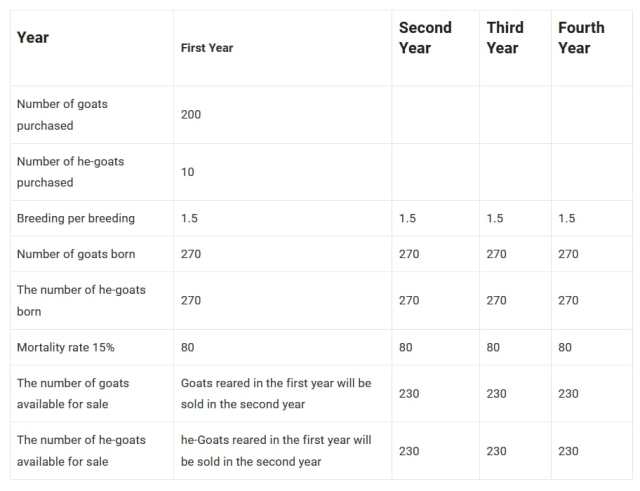
In the beginning, you bought 200 goats and 10 he-goats. After one year, you can sell 230 he-goats and 230 goats. The following table shows all about the herd of goats.
NOTE: The number of goats born as from the second year onwards can increase if you decide not to sell all of your born goats and keep some to grow your herd.
According to the above calculations, starting your farm with 200 goats and 10 he goats, will guarantee you making a profit of not less than Ksh.1,000,000 in after every 11 months of selling your grown new born goats.
Remember growing your herd also increases your profits/income.
Dairy Goat Farming – Cash Flow Budgets
The maintenance of a dairy goat farm is dependent on proper budgeting and cash flow on the farm. Click on the link below to watch a YouTube video that teaches you how to maintain proper budgeting and cash flow.
What capital is enough, or at least where do you start on this journey of becoming a dairy goat farmer?
Click on the link below to watch a YouTube video and learn about this.
CRITERIA TO SELECT GOAT BREEDING STOCK
Animal selection involves standards or criteria used to identify desired breed traits that parent animals can pass to their offspring. The goal of animal selection is to identify does and bucks that will improve herd hardiness and productivity. During the selection process goat producers must focus on reproductive, growth, and carcass characteristics.
Common goat selection tools are:
General visual appraisal
Pedigree data
Performance data
Genetic animal evaluation
Respective breed standards
Animal records
Selecting Replacement Doelings
Identifying replacement doelings (female goats less than a year old) in a breeding program is a multi-step process based on breed, season of birth, and management practices.
First screening. The first screening is based on weight and development when doelings are between 3 to 4 months of age. They are selected from their contemporary group in a herd and kept for further evaluation. At 6 to 8 months of age, doelings are re-evaluated based on growth and development within their contemporaneous group. Only doelings that have grown well and are structurally sound should be kept as replacement stock.
Further selection. Further selection is made at the yearling stage when the females are ready to breed. In this stage, selection is based on cyclicity and pregnancy. Young does that do not express signs of estrus (heat) or do not become pregnant are culled.
Final selection. The final selection is made after young does have weaned their first kids. Replacement prospects are determined according to whether the does adequately raised their kids. This evaluation practice is only valid when doelings are managed in a similar manner.
Other Traits to Consider
When selecting replacement doelings there are other important traits to consider.
Females must express femininity and maternal traits.
Good structural conformation—such as good feet and legs—is important.
The vulva must not be infantile. A small vulva with a tuff of hair is a sign of intersexuality.
The length of the upper jaw should be equal with the lower teeth touching the superior dental pad.
Mouth malformation will lead to difficulty eating efficiently. This trait can also be transmitted to offspring.
Desirable replacement females will exhibit a greater average daily weight gain during development in comparison to members of their contemporary group.
Breeding Does
The maintenance of mature breeding does should be based on reproductive performance. Does are expected to wean kids annually. A doe should also exhibit good structure. The udder must be of good structure, not pendulous. It must also have good ligaments, with one functional teat on each half, to facilitate nursing of the kids. Having oversized teats is a cull factor.
Other Valuable Doe Traits
Capability of breeding with no more than two services (rate to achieve pregnancy) required to conceive in a breeding season
Ability to carry out a pregnancy to term
Good milk production, which is indicated by the weaning weight of the kids
Detecting Reproductive Problems
A goat production system should rely on does that exhibit excellent reproductive performance. These does are able to reproduce, raise, and wean their kids with low input cost. The reproductive efficiency of a goat herd is determined by the kidding and weaning rates in a herd.
Another important trait is the prolificacy or the ability to deliver multiple kids. Goats should have a weaning rate of 1 kid per year. A rate of 1.5 kids per year is a good herd goal. The percent herd prolificacy can be calculated by the total number of kids born over the total number of does kidded in a season x 100:
percent herd prolificacy = number of kids born / number of does kidded x 100
percent herd weaning rate = number of kids weaned / number of does mated x 100
Criteria for Culling Does
Cull does with poor conformation of the udder and teats and/or with mastitis.
Cull poor reproductive performers with low profitability.
Does that present frequent prolapsed uterine, or the eversion of the internal uterine layer to the outside the doe’s vagina.
Eliminate does that have poor or low milk production and are incapable of rearing kids to weaning.
Remove does that fail to maintain adequate body condition.
SELECTING BREEDING BUCKS OR HERD SIRES
A herd sire or buck is the most important animal in the herd. The buck contributes 50 percent of the genetic makeup of every kid born and is a key factor in determining the overall pregnancy rate of the herd.
The choice of quality breeding stock is an important factor and fundamental in a meat goat operation. A replacement herd sire or buckling can be selected from the contemporary at weaning (3 to 4 months of age) based on weaning weight.
Subsequently, a post-weaning growth evaluation can be made by 6 to 8 months of age. At 8 months of age, a buckling can begin servicing a small number of females. At two years of age, bucks are considered adults capable of servicing many does.
Valuable Traits of a Buck or Sire Selection
A good buck must present male characteristics: masculinity, adequate muscling, conformation of the head and neck, and standard buck vocalization.
Bucks must have two testicles. The testicles should have a firm consistency, elasticity at palpation, good mobility in the scrotum, and be oval-shaped.
Adult bucks should present a scrotal circumference of 25 cm in average.
Bucks must not present abnormality of the mouth such as an undershot or overshot jaw.
Exhibit a good sense of smell.
Structural soundness like strong feet.
Criteria for Culling Bucks
Eliminate buckling from the herd that displays poor conformation such as cryptorchidism (a genetic malformation where only one or no testicles descend in the scrotum).
Remove a buckling with hypoplastia or undeveloped testicles. These conditions are usually signs of genetic abnormalities.
In addition, watch for orchitis, an inflammation of the testicle(s). These conditions can cause sterility.
Finally,
Attention to animal selection is critical for farm production success, but there is no single criterion for selecting the right stock. Farmers should be familiar with selection tools to ensure good selection and culling results in their herd.
END OF DAY 3 GOAT FARMING BUSINESS TEACHING SESSION
We now come to the end of today`s teaching session.
Our group is now open for questions and discussions on what we have learnt today.
Also below is a PDF file containing notes on what has been taught today.
Hello followers. Welcome to another day of our GOAT FARMING TRAINING
Why do you need a business plan?
There are three reasons why anyone may need a business plan.
First, if you`re about to start a business and you want to convince certain people to raise capital for you. In this case, you will want to use your business plan to “sell” your business idea to the investors so that they will be willing to finance your business.
Second, if you want to start a business and youre willing to be successful. Though you dont need external investors, you obviously need to grow, to compete and to win the battle of the market place, you need a business plan.
Third, you may need a new business plan because the economic or market situation has made your last plans obsolete. A Business plan is not like an academic paper which may stand for many years and still be relevant.
I wrote a business plan last year (I think April) and by December, it was already obsolete.
Why?
You really don`t know tomorrow. Your projections, plans or tactics are dependent on many factors that are beyond your power and when things change that affect your business (positively or negatively), then your plans also must be re-written.
A business plan is a very important part of every business venture and that is why you hear about it very often.
Unfortunately, most people who think about starting a business usually don`t consider writing a business plan.
I have read from different business experts about the fact that most start-up entrepreneurs do not write business plan but what I have not read from anyone is why this is so.
Why is it that most people have fear (so to say) about writing a business plan?
I know the answer.
You see, there are many myths and lies you probably have heard about the subject of business plan. Some people present business plan as if it was a university thesis or an academic report to be defended before certain professors.
Other people think that a business plan has to be 50 pages long and that it must be written in a certain “approved” format.
Well, I am here to tell you that all those opinions are not valid.
Because there are some ugly lies around this important business step, most people are “afraid” of doing it
Journey with me as i will reveal the real truth about business plan and at the end of today`s training, you will discover that it is actually easy to write a business plan.
1 – You need it
The most important benefit of a business plan is that it helps you to put all those beautiful dreams and ideas you have for your business on paper.
Contrary to what you may think; the business plans you have in your head and on paper are not the same. Taking the time to write down a plan for your business forces you to organize and refine your thoughts.
For the very first time, you will be able to see how everything is connected, and some important things you never really thought about will start to stand out.
On a mental level, writing a business plan will make you take yourself more seriously. Investing time, energy and focus to prepare a plan on paper feels like signing a contract with yourself. It increases the confidence and belief you have in your business idea and focuses your mind on those critical things that are obviously missing.
Before you have a plan on paper, all the ideas and plans you have for your business live inside your head. The problem is that they keep swirling around in a random and disorganized fashion. But when you have finished preparing your business plan, it feels like you have a map to your ‘promised land’ with a clear direction and a laser focus.
A business Plan helps you find the gaps in your idea and focus on the things that are really important.
When you interact with an entrepreneur who has taken the time to prepare a business plan, you will know. She is usually more articulate, confident and knows the business like the back of her hand because she can visualize the roadmap in her head. This is what you get when you go through the rigour of preparing a proper business plan.
2 – Banks and investors will want to see it
Depending on the amount of capital you’re asking for, most investors (including your parents or relatives) may want to see a plan that proves to them you know what you’re talking about.
Banks and formal investors (like angels and venture capitalists) want to know if your business can make enough profits to pay back a loan (with interest) and provide a good return on an investor’s investment.
Banks and investors would want to see your marketing plan. They want to see the profiles of the people who will run and manage the company. They want to see a cashflow forecast and your projected profits for the next 3 to 5 years. They want to see that you have analysed your competition and have a plan for your products and services.
Banks and investors will want to see all these things (and more) to convince themselves that your business deserves a loan or it is worth investing in.
Above all, having a well-prepared business plan is often a sign that you are a serious, organized and disciplined person. This is usually the kind of person investors and banks will want to give their money to.
3 – You can make money with it
You would be amazed at the number of business plan competitions that are available every year for African entrepreneurs and small business startups. Many of us don’t even know about them.
Business Plan competitions are usually sponsored by all kinds of local and international organizations to encourage small businesses and entrepreneurs with brilliant ideas.
Kenya’s Lorno Rutto is just one of many African entrepreneurs who raised startup capital by winning a business plan competition / entrepreneurship contest.
In 2010, she quit her bank job to start a waste recycling business.
Her company, EcoPost, collects and recycles waste plastic into aesthetic, durable and environmentally-friendly fencing posts that serve as an alternative material to timber.
But her business would have remained a dream without the financial support of international and local investors and NGOs.
Every year, hundreds of international and local organisations support businesses that tackle issues such as environmental pollution, illiteracy, disease and other social problems. They usually provide grants, donations, loans, equity or even training and advice.
The problem is, many African entrepreneurs don’t know about these funding opportunities, and as a result they don’t apply.
So in 2010, Lorna applied for and won a Ksh.600,000 SEED Award which served as start-up capital for her business. In the same year, she won a grant award of Ksh.1.2 million from the Enablis Energy Globe-Safaricom Foundation.
She also won a business plan competition organized by the Cartier Women’s Initiative, and received a prize award of Ksh.1 million.
Recently, her business attracted an equity investment from the Blue Haven Initiative and the Opus Foundation amounting to Ksh.5 million. This was used to expand the business and purchase advanced recycling equipment.
HOW LONG SHOULD A BUSINESS PLAN BE?
It all depends on your objective and who will read it.
The last business plan I wrote was written on a single sheet of A4 paper. I typed and printed it out.
If you intend to write a business plan for yourself and not to convince any investor, I strongly recommend that you write your business plan in a single sheet of paper or two, worst, three.
I know this is a strange advice so let me explain.
You see, human nature loves complexity while simplicity is the only valuable thing.
Anything that is too complex will give you stress and then become a burden on you, then you’ll abandon it … making it useless.
If you are planning to write a business plan for your own usefulness, you will have to review it often (or else you won’t even follow it), so tell me, which document is easier to review, a ten pages document or two?
You know the answer.
What if you want to write a business plan to convince the investors?
Some people will advise you to write 50 pages and some other entrepreneurs might have written 100 pages in the past, but let me tell you the truth, nobody has time to read your thesis except the university professors.
The only people who have so much time are the poor people and I am sure if at all you want to use your business plan to get an investor to finance your business, then you are talking about someone who is (probably) very busy.
Let me tell you this so that you will understand what I am saying here. Many CVs have been submitted to me by job seekers in the past and I am sure they would have prepared those CVs thinking, “I will impress the employers”.
Well, here comes the sad news … I have never in my life read a CV, I scan through them. I don`t have time.
Your business plan is like the CV for the job seekers. How long should it be?
Its again depends on who will read it. 10 pages may help you. 15 pages may help you, but when you`re going beyond 20 pages, I am out!
If you forget everything, make sure you dont forget this... the investors you will give your business plan, really dont have time.
HOW MANY YEARS SHOULD A BUSINESS PLAN BE?
Another area where people miss it. They are writing 5 or 10 years business plan.
Think about planning for your Goat Farming Business the way you think about goals for your life.
When I first learned about goal setting, I was impressed and I started by writing 5 to 10 years goals.
I was wrong.
It never worked. I later started writing one year goal and now I am writing goal for a third of the year (4 months).
The reason is simple… you`re a human being like all of us. What you think/plan may not happen the way you plan it.
Any agribusiness plan that is more than one year is actually questionable. That is my opinion. Any other business expert may tell you something different.
Let me to cross out a popular lie about business planning.
Most people believe that if your plan is well written, it will win you huge amount of money from the investors.
This is like telling a graduate, hey, if you can write your CV very well, you will be employed in a big company.
I hate certificates and CVs, and every single time people have submitted them to me, I have asked myself, what can this man/woman render as value for us (our business)?
Do you think I am the only one with this mindset?
Do you think your intending investors will be bought by a super-written plan? Think again.
Most investors will rather judge your five sentences than your 50 pages plans. That doesn’t mean that you shouldn’t write your plan very well. It simply means that you have more to do than just writing a plan.
You have to understand in and out, front and back, up and down of your intended Goat Farming Business.
In fact, the written plan is nothing but the abstract of what is in your head, or else, you will fail in your attempt to convince business partners or investors to help finance your agribusiness.
Some people believe that a business plan is what anyone (an expert) can sit down somewhere and just write for them.
Someone called me on phone sometimes back and that was what he wanted me to do for him. If I write a “superb” business plan for you, will I still be the one to defend it when your investors ask you questions?
That is why the first task you have is to understand your agribusiness very well.
3 EASY WAYS TO WRITE YOUR OWN BUSINESS PLAN
You can write a basic (one page or more) business plan by yourself in less than an hour or two. This is fine if all you need the business plan for is to organize your own thoughts and nothing more.
But if you need to convince an investor, enter a business plan competition or apply to a bank for a small business loan, you will need a plan that is much more detailed and looks professional.
To help you with this, we recommend the following three options to get you that perfect business plan you have been looking for…
Option 1 – Use free samples and business plan templates
Life is too short to be spent on reinventing the wheel.
If you’re new to business planning, it can be really helpful and inspiring to see some samples before you start writing your own plan.
With hundreds of free sample business plan templates out there, you don’t need to become a biz plan expert or pay an overpriced consultant to write one for you.
All businesses may not the same but a sample business plan allows you to choose a format that best resembles your business and adapt the format and content to suit your needs.
Say you want to start a dry cleaning and laundry business, you can use a sample business plan prepared for another Dry Cleaning & Laundry Services business to build your own plan. Since both businesses are quite the same, you will only need to change a couple of things and Voila! you have your own business plan.
You can visit this 2 sites for business plan samples;
Disadvantage(s): While using a sample business plan template is a quick and easy option, you may have problems with some parts of the plan that require specific skills like accounting, marketing and analysis.
Unless the financial and marketing plans you require are basic and will not require the detailed analysis that banks and investors often ask for, you may want to consider options 2 and 3 below which take care of these disadvantages.
Option 2 – Use business plan software
There are quite a number of good business plan software out there that can make writing your business plan an enjoyable experience. These pieces of intelligent software guide you step by step all through the writing process.
The outline for the business plan, titles, categories, and even charts, graphs and tables are automatically produced by the software. What is more interesting is that these software generate all the dreaded accounting information and financial statements which save you the stress of crunching numbers from scratch.
All you need to do is punch in the numbers and the financials are ready in a second!
The downside of using software to write your business plan is that they are rigid and standardized. This makes flexibility difficult as you can only work with the templates in the software.
In addition, it’s often difficult to apply specific knowledge and experience of a particular product, service or market to software; this is where the benefit of an expert business plan consultant comes in.
If you want a basic business plan which doesn’t need any special effects, then a business plan software should work for you. However, you must make sure that the software you purchase is not very expensive and offers good technical support (you’ll definitely need this).
If you think business plan software is the best option for you, we recommend that you use any of the following top products in the market.
Business Plan Pro from Entrepreneur Magazine (https://get.businessplanpro.com/eol/) comes in two editions (Premium and Standard). It has over 500 sample business plans to choose from and thousands of industry profiles that help you to understand the market and any competition that exists. The Premier Plan sells for $139.96 while the Standard Plan sells for $69.95
Live Plan by Palo Alto Software (http://www.liveplan.com) is also a great software with hundreds of sample business plans to choose from. It provides a flexible (pay-as-you-go) monthly payment plan of $11.66 and $19.95.
BizPlan.com (http://www.bizplan.com) is another powerful business plan software. It is an online-based tool that allows you to pick a business plan sample from its huge library, edit it to your taste and then print or share it over the internet.
Option 3 – Hire a business plan expert/consultant
In today’s beautiful internet world, it has become possible to outsource difficult tasks like writing a business plan.
With platforms like jiji.co.ke, ODesk.com and Elance.com, you can now hire an experienced business plan expert from anywhere in the world to write your business plan for you. All you have to do is post your request on any of these websites and all these bright minds will quote and compete for them.
It’s up to you to select the best offer after you have reviewed their profiles, checked their reviews, scores and ratings from previous jobs.
Working with a real-life business plan expert is much more flexible than a piece of software and the final plan can be customized to your taste.
And for business plans that require complex financial analysis, sales forecasts and other kinds of stuff that require critical thinking and an experienced hand to pull off, hiring a good business plan consultant is usually the better option.
On top of this, an experienced business plan writer often knows the things that banks and potential investors often look out for and can help to plug those leaks in your plan.
COMPONENTS OF A BUSINESS PLAN
In terms of writing a business plan format, there are ten basic elements you are expected to cover. The standard contents or format of a business plan includes:
An overview Executive summary General company description The opportunity Industry and market Your strategy The team A marketing plan Operational plan Financial plan An appendix.
Let’s now learn more about each component.
1. COVER LETTER
The cover letter serves the same purpose as it does when you submit one along with a resume as a job candidate; it introduces your business plan to the reader. Because your goal is to market your idea to prospective investors, creditors, partners, employees, and other stakeholders, all the parts of your plan must appeal to the reader. Here are the elements that you need to include in the cover letter:
Address of recipient
Date
Your address
Salutation (you must include a specific name as in, “Dear Mr James.”)
Body (state clearly that you are submitting a business plan for your business, which you can describe in one sentence; state clearly that you are seeking financial support for your business idea. Tell the reader what to expect in the following pages, and express your eagerness to hear back from them. Don’t forget to add your contact details)
Appreciation
Signature
2. TITLE PAGE
Remember, you will never get a second chance to make a first impression. So, you certainly don’t want to overdo this aspect. Since nobody will blame you for simplicity, stick with that option; which means you should avoid bright or contrasting colors and unnecessary fancy borders. The following are what to include on your title page:
Your business logo (if you have one)
The name of your business
Founder’s name
The words “Business Plan”
Date
3. EXECUTIVE SUMMARY
Your executive summary should be the opening page of your business plan. It is essential and shouldn’t be missed – any serious investor won’t read a business plan without an executive summary.
You should see an executive summary as the elevator pitch for your business plan. You need to grab the attention of your investors, summarize your business, and show that your plan is viable.
You will want to sell your investors on your story and show that your business has the voice, the products, and the audience to back it up. You will want to use short sentences throughout your executive summary, and use bullet points where possible. You will have a lot of information to cover and you don’t want to lose your investors’ attention.
Each section in your executive summary will act as a sample for the later chapters of your business report. You will want to capture all the important information without getting too bogged down in the details.
Most investors don’t read the rest of the business plan if they aren’t grabbed by the executive summary.
Components of a Business Plan Executive Summary
Business concept (what you do or what you intend to do)
Business goals and vision (what you want to achieve)
Product/service description and differentiation (what you offer and what makes it different)
Target market (who you want to sell to)
Marketing plan (how you plan to reach your customers)
Current financial state (what you currently make in revenue— if you already have an existing business looking at expansion, or how much you already have on ground— if you are starting a business)
Projected financial state (what you foresee making in revenue)
The request (how much funds you are asking for)
The team (who runs your business)
A description of products/services
You will want to begin by talking about what your business does. You may want to use the P.A.S introduction system – you present the problem, aggravate it, and then provide the solution to it. The solution being your product or service.
Summary of your objectives
Use bullet points for this section. Summarize your business’ main objectives. You can talk about the number of potential sales you are aiming for, market positioning, and your other intentions. Most importantly, make sure the rest of your plan shows that you can achieve these goals with ease.
Strong understanding of your market
This section should act as a taster menu for your market research and marketing plan. You need to show that you understand the market you want to move into, as well as past and current trends.
Briefly cover your advertising and social media plans. You may also want to give an idea of how you want your brand to look online. As well as, detailing some buzzwords you want to associate with your business.
Potential for growth/ funding overview
In this section, you should lay out the amount of funding you are looking for (if you need funding), how you plan to spend it, and what kind of profits you are looking to make. You should look at including 1 year, 3 year, 5 year, and 10 year profit predictions. You should also keep these figures realistic and make sure that they are backed up throughout the rest of the document.
Your competitive advantage
In this section, you should explain how you are able to offer something your competitors can’t and how you are planning to eat into their market share.
Company Description
You will want to use this section to introduce your company to the people reading your business plan. By the time they finish reading this section they should understand your company’s mission statement, its structure, what it plans to do, and how it plans to do it. This section will be more detailed than your executive summary, and it will cover all the essential information about the day-to-day running of your company.
Details about your company e.g. location
Start this section by talking about where the company is going to be based. This will be very important for investors (and you), as it will affect what kind of tax will be paid on profits. Then you should talk about whether your business will have a physical location, or whether it will function in another way.
Talk about the different types of locations your business will need to function – i.e. a physical store, a warehouse, a server farm, etc.
How large the company is
In this section, you will want to talk about two things- what your company is worth and how many people you will need to employ (or already employ) to keep it running. These two topics go hand in hand, as you will have to prove that your business will be able to make enough money to support its payroll. You do not need to cover the management structure of your business here.
What your business actually does
In this section, you will want to present your mission statement for your company. This should include why your company exists, what its role is (are you a B2B or a B2C business), and what its overall goal is. You should share your process in detail here. For example, if you are planning to sell hats, you should briefly talk about the process of getting the materials, making the hats, and how you plan to sell them at a profit.
What you hope to accomplish
Here you should expand on your company’s overall goal. Include any smaller goals, you have as a company – for example if you plan to have stores in multiple towns within 3 years.
In this section, you don’t have to show how you plan to make your dreams possible. But you should make sure that you do cover that in the rest of your business plan – investors will look for these answers and won’t be happy if they are not there.
4. YOUR COMPANY’S PROFILE
A company profile is a formal introduction of your business. It usually contains all you would want potential clients, investors, and the general public to know about your business. It is used as a marketing tool and it is your company’s unique selling point.
A complete company profile is expected to contain the vision, mission, and goals of the company, a detailed description of the product and service offering of the company, the profile of the founding members of the company, a brief story of how the company got started and what they intend to achieve. So also, information like company name, address, phone number, website and email e.t.c must be part of your company profile.
Components of your Company’s Profile
Structure of your business (sole proprietorship, general partnership, limited partnership, or an incorporated company)
The date your business was established (for existing businesses)
The nature of your business (what are you selling, or what are you planning to sell?)
The industry you are in
Business vision, mission, and values
Background information on your business or its history
Business Objectives (short and long-term)
The Business team
5. PRODUCTS AND SERVICES
In this section, you will want to outline the products and services you are planning to provide when you launch. As well as any products or services you plan to launch in the future. You should present your ideas about prices and profits in this section too.
A description
This section should include a description of the products or services you are offering or plan to offer when your company launches. By this point you should have made it clear why these products are necessary, so that you will not need to waste space by explaining how they solve the problem you presented in your mission statement.
How the products and services will be priced
This is one of the most important parts of this section. Here you will show how your business plans to make money. If this section doesn’t sell your business to investors, nothing else will. You should cover the price of your product, as well as breaking down the costs and profits of each item or service. Your expenses and markups should be clear to anyone, even if they are just skimming through the document.
A comparison of the products or services your competitors offer in relation to yours
In this section, you will need to explain what makes your business and your products different from your competitors. You should talk about what new things you bring to the market. And how you plan to improve on your competitors’ business plans.
This is particularly important if you are planning to charge more than your competitors. You will need to convince your investors that customers will want to choose your more expensive option.
Sales literature
Here you should include copies of any sales literature you plan to use. If you don’t have any yet then you should include some mockups of the final literature. This is not to be confused with the advertising you are planning to use.
Any intellectual property, such as trademarks, or legal issues you need to address
In this section, you will want to detail any trademarks that you have made in the name of your company as well as any other intellectual property you have a claim to or are planning to trademark. You should be honest in this section, if you have any legal issues you need to address as a company. It is better for your investors to find out about these things beforehand.
Future products or services you plan to offer
This is the section where you can prove to your investors that you are not just a one-hit-wonder and that you have the knowledge to evolve and keep your company making money even after the market changes. Here you should display any other products you plan to offer in the future.
6. YOUR INDUSTRY ANALYSIS
In this section of your business plan, you will demonstrate that the industry’s market size is worth going after, who your main competitors will be if you decide to take a plunge, and how you will be able to carve out a niche for yourself and give your competitors a run for their money.
Planning a business goes beyond analyzing the potential of your offer. You must analyze the following three factors as well:
The strengths and weaknesses of your business
The competition
Who your customers are, what they want, and how they want it
These are the major components of a business plan’s market or industrial analysis and it is also known as a SWOT (Strength, Weaknesses, Opportunities and Threats) analysis. This section of your business plan reveals the chances of your business to achieve success with its offers.
And that’s why the industry analysis is a very important section of your business plan, which must be carefully conducted and documented. This chapter covers everything you need to know about competition analysis, market size and target audience, market forces and trends, environment analysis and risk assessment.
7. MARKETING PLAN
We find that many entrepreneurs find this section the hardest to put together. If you feel like you are struggling, we recommend hiring a marketing expert to help you put together a marketing plan – as this will be a section investors pay a lot of attention to. It also answers your most important marketing questions about your customers/clients which include:
Where do they live?
What’s their age range?
What’s their level of education?
How many of them are there?
What are some common behavior patterns?
What do they spend their free time on?
Where do they work?
What technology do they use?
What ethnicity are they?
How much do they earn?
Where are they commonly employed?
What are their values, beliefs, or opinions?
Products and services and your unique selling proposition (USP)
What makes your product unique? Why should your customers spend their hard earned money on your product? What will keep them coming back for more? What makes your product better than your competitions’ products?
These are the questions that you will need to answer in this section. This should be a customer-focused section that really shows how your customer will benefit from your product and interacting with your business.
Pricing strategy
Here, you will want to go back over your price point, your costs, profits, margins, and markups. However, in this section, you will want to compare these figures to your competitors and their products. If you are spending more on materials you will need to justify it.
If you can include exact details about your suppliers, then do.
Sales and distribution plan
In this section, you will cover how your product (or service) is going to get from the factory and into the customer’s hands.
Will you sell your products online? In your own stores?
Will you have it stocked in larger stores? If so, how will you pick out stores that align with your brand values?
What channels will you use to get your product out there? Will you sell via your website, a retailer, wholesaler, or a totally different channel?
How will customers pay for your product?
What will your return policy look like? Will you offer any guarantees? If so, what will they look like?
What happens after a customer makes a purchase? What type of customer support will you provide?
You will need to talk about batch numbers and how much that will cost upfront.
Advertising and promotions plan
This should be the longest section in your marketing plan. Here you will cover how you will build buzz before the launch of your first product. Then how you will keep the excitement and sales going. You should discuss how other companies have done this and show that you know the best way to advertise your target audience.
You should talk about promotions, what response you expect to see from them, and how you will make up any money lost.
Will you have a dedicated presence across many of the popular online channels (such as website, social media, relevant marketplace, etc) used today to gain brand awareness?
Will your marketing plan be primarily inbound focused (such as SEO, social media, blogging, etc), outbound focused (such as PPC, affiliate marketing, sales teams, etc), traditional focused (such as direct mail, brochures, and print advertising), or a mix of all three?
What are other low-cost yet effective marketing mediums that you will leverage to get attention?
What is your PR strategy? Why would the press be interested in your story?
Social media
Long gone are the days when a company can get away with pitching without a social media plan. The power of social media is strong right now, that with the right selection of pictures on Instagram, companies can gain thousands of followers before anyone knows that they are selling.
While poor social media presence won’t destroy a business. A good social media presence can make one a success. When putting this plan together, you will want to make sure you show that you understand how your target audience uses social media, what social media they use, and when they use it.
For example, if you are planning to offer a B2B (business to business) service, then you should be present, posting, and advertising on Linkedin. But if your social media plan for your B2B (business to business) service focuses on Instagram, your investors might be concerned that you hadn’t really researched your market.
However, if you were looking at selling products to moms with teenagers – then Facebook would be the right place for you. Its average user is a female between 35 and 45.
If you do not feel like you understand the field of social media well enough then you may want to hire someone to help you put this plan together and implement it.
8. OPERATIONAL PLAN
This will be the least glamorous section of your business plan (and probably the most boring section to write). But that doesn’t make it any less important. In this section, you will show your investors that you understand how your business will run on a day-to-day basis and that you are prepared for that. Here you will show your strategy and implementation plans.
Objectives
This is the place to discuss the fundamental goals of your business. For example, you want to be turning a profit after 6 months. You want to have 100 employees by the end of the first year. You would like to open a second store before the business turns 5.
Here, you should step out these goals with a point-by-point plan underneath them. Depending on the type of goal you might want to put a timeframe on the goals or use some other tangible measure of success. These goals should be related to keeping the business profitable – for example, talking about social media based goals in this section is irrelevant.
Timeline
There are two different types of timelines you need to consider in this section. Firstly, you should be looking at production timelines. These should include the timeline that covers you putting in an order for your product to the time when it arrives on the shelf.
This will give you an idea of how far in advance you will have to plan launches and how long restocking products might take. Secondly, if you are planning to expand or have set yourself tangible goals – you should have a timeline for achieving these goals set out.
Procedures
In this section, you will want to break down the day-to-day operations of your business. Talk about opening hours, holidays, and seasonal variables. Cover any of the assets that the business has or will acquire. Cover the equipment the business will be using.
You will want to talk about your plans for product testing, for acquiring materials, and for meeting health and safety standards. You will need to outline how any physical premises will be run. Talk about whether they will need power, water, drainage, etc. You should provide a detailed cost analysis of everything that you have covered in this section.
The Production Process
You will also need to give details of your entire production process, and that means answering the following questions:
How long it will take you to produce a single unit or a predefined number of units?
What measures have been put in place to integrate customer feedback into your product or service? As in, have you allotted time to create and test prototypes, pricing, or delivery mechanisms?
How will you deal with major influxes in demand? That is, what procedures or steps will you have in place when you offer a sale and orders come flying in?
The Supply Chain
Let’s start with the workflow that you will have to deal with to make your ideas a reality. Some of the things you will want to touch on are as follows:
Suppliers: Who will be providing you with all the materials that you won’t be manufacturing yourself?
Facilities: Where will you house your inventory (if any), or which office will you use for your operations?
Personnel: How many staff will you require for your daily operations? What will their duties look like?
Equipment: What tools and technology do you require to be up and running or to take your company to the next level? (This could include everything from computers to office desks and everything in between).
Shipping and fulfillment: Here you will have to outline whether you will be handling all the deliveries on your orders or if you will be using a third-party fulfillment partner.
Inventory: Here you will highlight how much you will keep on hand, where it will be stored, and how you will have it shipped to third-partners if applicable. Also, an important detail to note is how you will keep track of everything going in and out.
Customer support: How will support requests, refunds, and customer complaints be considered and integrated in your business workflow?
In essence, this section should signal to the reader that you have a good handle of running your business. It also passes the message that you have a contingency plan in place to account for uncertainty in the marketplace. By taking this advice into account you will create a more convincing operational plan.
9. MANAGEMENT PLAN
This is the area of your business plan that you will have to update most frequently, particularly at the beginning of your journey when you are seeking funding. When you first write this business plan, this section may be a proposal to possible lenders. With you offering them stakes in your company, rather than sharing concrete facts about who owns what.
As you are gathering investors, you should make sure to update your management plan between meetings. You don’t want to bring people into a team with accidental false promises or with an incorrect idea about their position in the company.
Ownership
This is the section where you will outline who owns what parts of your business. If the company is very new then it may just be owned by you and your fellow founders. If you have put money into the business then you may want to list yourself as a stakeholder.
How you list yourself will affect the tax you pay on the company’s profits. If you are looking to draw investors into your business then you can use this section to show what percentage of the business is up for sale and the predicted profits for the future owner.
Management
In this section, you will be detailing the experience and the roles of the management team you have in place to run the business. The idea behind this section is that you want to reassure possible investors that the business is being run by experts in the field who know what they are doing.
An experienced management team is less of a risk for your investors. If you don’t have a team put together yet then you can just discuss the structure of the team you hope to build. Your investors may want to have a say in who you hire or how the team is structured.
If that is something you are open to, you can mention that in this section.
Board
The final part of your management plan should be about the board of directors at your company. Companies that are in the early stages of fundraising will not have a board in place. This is nothing to worry about. Take a similar approach with this section to your ownership section.
Talk about the kind of board you would like to set up and how someone would earn their place on this board. Talk about the kind of people you want taking up those spots -you can talk about both experience and attitude. If you do have a board then you want to talk about their roles and experience in this section. Show possible investors that your board members will look after their money.
10. BUSINESS GROWTH STRATEGY
In this chapter, you will learn how to devise your short and long term business growth strategy. This is important because investors want to know your long term expansion plans and where your company will be in the next five to ten years.
How to Present your Business Growth Strategy
*Explain the development options and opportunities in detail.
*Review and document the financial requirements for each option.
*Document the marketing strategies you will need to accomplish and nurture your chosen growth option.
*Review the financial breakdown of internal or external capital and how the capital will be made available throughout the growth process.
*Document a breakdown of other things that will be needed, expanded, or ditched.
*Print your growth plan and review it regularly until you are ready to implement it.
11. FINANCIAL PLAN
This is another section that many entrepreneurs struggle with. It is very important to get the numbers in this section right, as you do not want your investors to think that you are trying to mislead them. If you don’t feel like you can put together a financial plan on your own you should hire someone to help you do it.
In this section, you are going to cover all the financial elements of your business. Including what kind of investment you are looking for, how much the day-to-day running of the business costs, and any new investment you think you will need over the next 5 years.
The amount of money to set up or maintain the business
This section will be different for every business, but you should have a clear figure at the top of the page that shows how much it will cost you to set up your business (or to maintain it in its current state).
Underneath that, you should have a breakdown of all the different costs that make up that final number. Try to keep this section to a page. If needed you can put more detailed notes in an appendix and refer the reader to that page for more complicated sums. You want to keep this section as clear as possible.
The amount needed for the next few years
Next, you will want to take a deep dive into how you think the day-to-day running costs of the business will change over the next few years. You should also discuss any big expense that you can foresee. For example, if your bakery business picks up, you might need to buy a second oven to meet demand and hire an extra baker.
You may want to do a couple of sets of calculations showing how different rates of growth would affect the costs of running your business. For example, slower than expected growth, expected rate of growth, 5% faster growth.
How do you plan to spend funds?
This section is about mapping out what you will do with the money you are requesting and any money you make as a business. This will include loans, investments, grants, sales, and profits. You should talk about how you will be spending your money and how it will benefit the company or why it is essential you spend the money in that way.
For example, you may want to invest in electric vehicles for the company’s fleet. While the initial cost will be higher than buying petrol cars, the fuel costs will quickly make up for this.
Ongoing business expenses e.g. salaries
Finally, you are going to want to break down the ongoing costs of running your business. These are costs that are unavoidable and shouldn’t be ignored when you are working out how much it costs to run your business. Three key examples of ongoing costs are salaries (the wages you pay your employees), taxes (the money you pay to the government), and rent on your buildings.
You should explain what the tax rules are in your line of business in this part of the document, as business taxes vary wildly across the country. This will be especially important for any international investors.
12. PROJECTIONS
The role of your projections section is to convince the people reading your business plan that your business is built to make money. You want to show possible investors that your company and ideas aren’t a risky investment. Instead, they are a great opportunity.
In this section, you will want to be optimistic but not unrealistic. Again, you do not want to bring investors in with false promises, as this could get you in legal trouble in the future.
Components of a Business Plan Financial Statement
Income statement
This beautiful composition of numbers tells the reader what exactly your sources of revenue are and which expenses you spent your money on to arrive at the bottom line. Essentially, for a given time period, the income statement states the profit or loss (revenue-expenses) that you made.
Balance sheet & Cash flow statement
This section is only for businesses that are already established and are looking for further investments. In this section, you will want to include as much financial information about your company as possible. This is in order to give investors the opportunity to see that your business is already making money and is not a sinkhole for cash.
You should include these documents for the last 5 years or however long your business has been open if less than that:
A complete set of balance sheets
All your cash flow statements
List of company expenses
Income statements
Payroll details
Financial Outlook
In your financial outlook, you want to paint a similar picture of success. You want to use this section to show how your investor’s money could be put to work and make them even more money in return. You should prepare your predictions for the next 5 years.
You should devote more space to the first year, covering it with quarterly reports, rather than annual ones. We would also recommend that you put two 6 month reports in for the 2nd year. You should include the following information in your financial outlook.
Capital expenditure budgets
A complete set of balance sheets
All your cash flow statements
List of company expenses
13. BUSINESS EXIT STRATEGY
You are not going to die with your business; neither are your investors. This is why you need to prepare an exit plan not just for yourself but also for your investors. An exit strategy is a method by which entrepreneurs and investors, especially those that have invested large sums of money in startup companies, transfer ownership of their business to a third party, or by which they recoup money invested in the business.
Some forms of exit strategies include, being acquired by another company, the sale of equity, a management-employee buyout, etc.
Types of Exit Strategy
Initial public offering (IPO)
Selling your business
Acquisitions and mergers
Liquidation of assets
Management buyout
Family succession
14. FINAL PART
Appendices – Prototypes, statements, contracts, legal documents, etc.
Appendices of a plan
In this final section, you should include anything that is relevant to your business proposal as well as anything you refer to throughout the document. You should not expect your investors to go online and find an article for themselves, instead include it in your appendix.
To make your appendix easier to follow, include a contents page and clearly label the appendices. You could even use a color-coding system – i.e. all the appendices related to your financial plan have a green bar across the top of the page.
A SAMPLE GOAT FARMING BUSINESS PLAN
1. Industry Overview
The agricultural industry of which livestock farming or better still goat farming is a subset of is no doubt among the leading industry in most countries of the world; it is the industry that produces food for the populace and raw materials for industries.
Because of the significant role the agriculture sector plays, the government of most countries ensures that they go all the way to subsidize seedlings, fertilizers, and farming implements and machinery for farmers and also encourage entrepreneurs to go into various kind of farming including goat farming.
There are several business opportunities available in the agricultural industry and one good thing about the industry is that there is market for all the produce from the industry. Goat farming is of course a thriving and profitable business because usefulness of goat meat and other by products from goats.
People eat goat meat, drink their milk, and use their fur and skin. With goat milk, cheese can be made, along with other dairy products. Some farmers use goats for weeding farmland. Other times, the goats are used to keep grasses and other plants from getting too tall. The diet of the domestic goat includes eating grass, leaves, shrubs, root vegetables, and other kinds of plants.
Goats come in different breeds with each breed having its own unique specifications and uses. Some goat breeds known as ‘dairy goats’ are raised mainly for the milk that they produce while some other breeds can grow very big and fat, hence, they are raised for meat purposes.
You must first decide on why you want to raise goats and then select a breed that is most suitable for that purpose. You could also raise both dairy goats and regular goats if you can afford to feed and care for them. The livestock production industry includes companies that mainly provide support services for raising livestock.
Livestock is a term used to describe domestic animals, such as cattle, goats, hogs, horses, poultry and sheep, which have been domestically raised for meat, milk, wool and work. Other services in the livestock production industry include breeding services, pedigree record services and vaccination et al.
The Livestock Farming (Goat Farming) industry is indeed a large industry and pretty much active in countries such as United States of America, Israel, Egypt, China, Germany, Turkey, Kenya and Nigeria etc.
There is no single livestock farming company that has dominate market share in the industry hence smaller goat farming business can successfully make profits.
Statistics has it that in Kenya alone, there are about 2,712 registered and licensed livestock farming business responsible for employing about 67,814 and the industry rakes in a whooping sum of 50 billion shillings annually. The industry is projected to enjoy 1.4 percent annual growth.
If you are looking towards leveraging on the agriculture industry to generate huge income, then one of your best bet is to start goat farming business. Goat farming business is all about mass – breeding of goats for the sole aim of making profits. In most cases it is referred to as livestock farming business.
One thing is certain about goat farming business, if you are able to conduct your market research and feasibility studies, you are more likely not going to struggle to sell your goats because there are loads of people out there who eat goat meat, drink goat milk and industries that make use of byproducts from goats in manufacturing their products.
Over and above there are few barriers to entry into the livestock production industry.
2. Executive Summary
Kirui Farms Ltd is a registered and licensed livestock farming company that will be based in the outskirt of Kitengela, Kajiado County – Kenya. We have done our detailed market research and feasibility studies and we were able to secure 2 acres of land to start our livestock breeding business.
Our livestock breeding business is a going to be standard one hence will be involved in commercial breeding of goats and other livestock. We will be involved in boarding services, breeding services, dairy support services, livestock health services, farrier services, and shearing services etc.
In the nearest future, hopefully within the first five years of officially running Kirui Farms Ltd, we will start our meat processing plant and also start exporting our products to other parts of the world.
Which is why aside from the fact that we have secured the required farming land for breeding goats in commercial level, we have also hired some key employees who are currently undergoing training so as to be able to fit into the ideal picture of the 21st century livestock breeding workforce that we want to build.
We are in the goat farming business because we want to leverage on the vast opportunities available in the livestock farming industry, to contribute our quota in growing the Kenyan economy, in national food (meat) production, raw materials production for industries, to export agriculture produce from Kenya to other countries and over and above to make profit.
Kirui Farms Ltd is well positioned to become one of the leading goat farming business in Kenya, which is why we have been able to source for the best hands and equipment to run the business.
We have put process and strategies in place that will help us employ best practices when it comes to livestock breeding / goat farming processes and meat processing and packaging as required by the regulating bodies in Kenya.
Kirui Farms Ltd is a private registered livestock farming company that is owned by Mr. Kirui and Family. The company will be fully and single handedly financed by the owner – Mr Kirui and his immediate family members at least for a period of time.
Before starting Kirui Farms Ltd, Mr Kirui has worked with some of the leading livestock farms in Kenya. He has worked in the industry for well over 10 years before resigning to start his own goat farming business.
3. Our Products and Services
Kirui Farms Ltd is a licensed livestock farming business that is committed to goat farming and meat processing and packaging for both the Kenyan market and the global market. We will also produce related raw materials for industries in commercial quantities.
We will also ensure that we operate a standard food processing plant as part of our complimentary business offering. These are the areas we will concentrate on in our livestock farming business. If need arises we will definitely add more related animal breeding services to our list;
Boarding services
Breeding services
Dairy support services
Livestock health services
Farrier services
Sale and export of cotton wool and other dairy products
Sale of Cattle and milk (Including goats, sheep, grass – cutters, pigs and rabbits et al)
Sale of processed meat (beef) / can – beef (Processed Diary foods, and can beef et al)
Shearing services
Livestock farming related consultancy and advisory services
4. Our Mission and Vision Statement
Our Vision is to become one of the leading livestock farming brands not just in Kenya, but also in Eastern Africa.
Our mission is to sell our produce (goats), byproducts and processed meat in commercial quantities both locally, nationally and internationally.
We want to build a livestock farming business that can favorably compete with other leading livestock farming brands in Kenya and in the world.
Our Business Structure
Kirui Farms Ltd is a livestock farming company that intend starting small in Kitengela, but hope to grow big in order to compete favorably with leading livestock farms in the industry both in Kenya and on a global stage.
We are aware of the importance of building a solid business structure that can support the picture of the kind of world class business we want to own. This is why we are committed to only hire the best hands in Kenya.
At Kirui Farms Ltd, we will ensure that we hire people that are qualified, hardworking, dedicated, customer centric and are ready to work to help us build a prosperous business that will benefit all the stake holders (the owners, workforce, and customers).
As a matter of fact, profit-sharing arrangement will be made available to all our senior management staff and it will be based on their performance for a period of five years or more as agreed by the management of the farm.
In view of the above, we have decided to hire qualified and competent hands to occupy the following positions;
Below is the business structure of Kirui Farms Ltd;
Chief Operating Officer General Farm Manager Administrator / Accountant Cattle Ranch Manager / Supervisor Sales and Marketing Executive Field Employees Front Desk Officer
5. Job Roles and Responsibilities
Chief Operating Officer:
Increases management’s effectiveness by recruiting, selecting, orienting, training, coaching, counseling, and disciplining managers; communicating values, strategies, and objectives; assigning accountabilities; planning, monitoring, and appraising job results; developing incentives; developing a climate for offering information and opinions; providing educational opportunities.
Responsible for providing direction for the business
Creating, communicating, and implementing the organization’s vision, mission, and overall direction – i.e. leading the development and implementation of the overall organization’s strategy.
Responsible for signing checks and documents on behalf of the company
Evaluates the success of the organization
General Farm Manager
Responsible for the planning, management and coordinating all farm activities across the various sections on behalf of the organization
Supervise other section manager
Ensure compliance during project executions
Providing advice on the management of farming activities across all section
Responsible for carrying out risk assessment
Using IT systems and software to keep track of people and progress of the growth of crops, fishes, birds and animals
Responsible for overseeing the accounting, costing and sale of farm produce after harvest
Represent the organization’s interest at various stakeholders meetings
Ensures that farming goals desired result are achieved, the most efficient resources (manpower, equipment, tools and chemicals et al) are utilized and different interests involved are satisfied. Responsible for preparing financial reports, budgets, and financial statements for the organization
Responsible for overseeing the smooth running of HR and administrative tasks for the organization
Defining job positions for recruitment and managing interviewing process
Carrying out staff induction for new team members
Responsible for training, evaluation and assessment of employees
Oversee the smooth running of the daily farming activities across the various farming sections.
Administrator / Accountant
Responsible for overseeing the smooth running of HR and administrative tasks for the organization
Defining job positions for recruitment and managing interviewing process
Carrying out staff induction for new team members
Responsible for training, evaluation and assessment of employees
Responsible for preparing financial reports, budgets, and financial statements for the organization
Responsible for financial forecasting and risks analysis.
Responsible for developing and managing financial systems and policies
Responsible for administering payrolls
Ensuring compliance with taxation legislation
Handles all financial transactions for the company
Serves as internal auditor for the company
Cattle Ranch and Animal Manager / Supervisor
Responsible for managing the commercial breeding of goats and other livestock.
Responsible for managing boarding services, breeding services, dairy support services, livestock health services, farrier services, and shearing services et al.
Work closely with the General Manager to achieve the organizations’ goals and objectives
Sales and Marketing Officer
Identify, prioritize, and reach out to new partners, and business opportunities et al
Identifies development opportunities; follows up on development leads and contacts; participates in the structuring and financing of new business
Writing winning proposal documents, negotiate fees and rates in line with company policy
Responsible for handling business research, marker surveys and feasibility studies for clients
Responsible for supervising implementation, advocate for the customer’s needs, and communicate with clients
Develop, execute and evaluate new plans for expanding increase sales
Document all customer contact and information
Represent the company in strategic meetings
Help increase sales and growth for the company
Field Workers / Contract Staff
Responsible for feeding goats and other livestock as instructed by the supervisor
Responsible for cleaning the cattle ranch
Change the water in fish ponds as instructed by the supervisor on a regular basis
Handles farm implements and machines as instructed by the section manager / supervisor
Assist in handling the breeding of goats
Carries out task in line with the stated job description
Assist in transport working tools and equipment from the farm and back to the designated store room
Handles any other duties as assigned by the line manager
Client Service Executive / Front Desk Officer
Welcomes guests and clients by greeting them in person or on the telephone; answering or directing inquiries.
Ensures that all contacts with clients (e-mail, walk-In center, SMS or phone) provides the client with a personalized customer service experience of the highest level
Through interaction with clients on the phone, uses every opportunity to build client’s interest in the company’s products and services
Manages administrative duties assigned by the manager in an effective and timely manner
Consistently stays abreast of any new information on the company’s products, promotional campaigns etc. to ensure accurate and helpful information is supplied to clients
Receives parcels / documents for the company
Distribute mails in the organization
Handles any other duties as assigned by the line manager
6. SWOT Analysis
Kirui Farms Ltd does not intend to launch out with trial and error hence the need to conduct a proper SWOT analysis. We know that if we get it right from the onset, we would have succeeded in creating the foundation that will help us build a standard goat farming business that will favorably compete with leading livestock farms in Kenya and in the rest part of the world.
As a goat farming business, we look forward to maximizing our strength and opportunities and also to work around our weaknesses and threats. Here is a summary from the result of the SWOT analysis that was conducted on behalf of Kirui Farms Ltd;
Strength:
Our strength as a livestock farming business is the fact that we have healthy relationships with loads of major players (agriculture merchants) in the livestock farming industry; both suppliers and buyers within and outside of Kenya.
We have some of the latest livestock farming machines, tools and equipment that will help us breed goats and other livestock in commercial quantities with less stress. Aside from our relationship (network) and equipment, we can confidently boast that we have some the most experienced hands in livestock farming industry in our payroll.
Weakness:
Our weakness could be that we are a new livestock farms in Kenya and we may not have the required cash to pump into the publicity of our business. We are aware of this and from our projection will overcome this weakness with time and turn it to a major advantage for the business.
Opportunities:
The opportunities that are available to us cannot be quantified, we know that there are loads of homeowners, and industries that will source for goats, goat meat, and milk and also industries that will source for the raw materials from our livestock farms both in Kenya and other parts of the world.
Threat:
Some of the threats and challenges that you are likely going to face when you start your own livestock farm are global economic downturn that can impact negatively on household spending, bad weather cum natural disasters (draughts, epidemics), unfavorable government policies and the arrival of a competitor (a commercial farm that rears same animals) as our livestock farms within same location.
There is hardly anything you can do as regards this threats and challenges other than to be optimistic that things will continue to work for your good.
7. MARKET ANALYSIS
Market Trends
One of the common trends in the commercial livestock farming line of business is that most players in the industry are no longer concentrating only on farming a particular species of livestock or just livestock / goat farming alone.
They now find it easier to run both livestock farming and crop cultivation. Some even go ahead to include meat processing and packaging business alongside their product offerings; it helps them maximize profits in the agriculture industry.
Despite the fact that commercial goat farming / livestock farming has been in existence since time immemorial, that does not in any way make the industry to be over saturated; commercial goat farmers are exploring new technology to continue to improve goat farming processes and also meat preservation and packaging process. The fact that there is always a ready market for commercial goat farming makes the business ever green.
As a matter of fact, one of the new trends in livestock farming industry is that with the recent advancement in technology livestock farmers can now improve the various breeds of the animals they are breeding.
As a matter of fact, it is now easier for livestock farmers to comfortably import the kind of breed of domestic animal they want to breed from any country of their choice and also advancement in technology has made it easier to cross – breed different animal.
9. Our Target Market
Naturally, the target market of those who are the end consumer of livestock farm produce and also those who benefits from the business value chain of the agriculture industry is all encompassing; it is far – reaching.
Every household consumes produce from livestock farms be it goat meat, goat milk, and the skin (leather) used for bags, belts and shoes production et al. So also a large chunk of manufacturing companies depends on livestock farms for some of their raw materials. In essence a goat farmer should be able to sell his or her farm produce to as many people as possible.
We will ensure that we position our business to attract consumers of agriculture produce not just in Kenya alone but also other parts of the world which is why we will be exporting some of our farm produce either in raw form or processed form to other countries of the world.
Our Competitive Advantage
It is easier to find entrepreneurs flocking towards an industry that is known to generate consistent income which is why there are more commercial farmers in Kenya and of course in most parts of the world.
These goes to show that there are appreciable numbers of farmers in Kenya but that does not mean that there is stiffer competition in the industry.
As a matter of fact, entrepreneurs are encouraged by the government to embrace commercial farming / livestock farming. This is so because part of the success of any nation is her ability to cultivate her own food and also export foods to other nations of the world.
Kirui Farms Ltd is fully aware that there are competitions when it comes to selling livestock and meats all over the globe, which is why we decided to carry out thorough research so as to know how to take advantage of the available market in Kenya and in other parts of the world.
We have done our homework and we have been able to highlight some factors that will give us competitive advantage in the marketplace; some of the factors are effective and reliable livestock farming processes that can help us sell our livestock and processed meat at competitive prices, good network and excellent relationship management.
Another competitive advantage that we are bringing to the industry is the fact that we have designed our business in such a way that we will operate an all – round standard commercial livestock farms that will be involved in diverse areas such as animal rearing and meat processing and packaging plant. With this, we will be able to take advantage of all the available opportunities within the industry.
Lastly, our employees will be well taken care of, and their welfare package will be amongst the best in the industry meaning that they will be more than willing to build the business with us and help deliver our set goals and achieve all our objectives as a standard commercial livestock farms with a meat processing and packaging plant.
9. SALES AND MARKETING STRATEGY
Kirui Farms Ltd is in the livestock breeding industry for the purpose of maximizing profits hence we have decided to explore all the available opportunities within the industry to achieve our corporate goals and objectives. In essence we are not going to rely only on the sale of our livestock to generate income for the business.
Below are the sources we intend exploring to generate income for Kirui Farms Ltd;
Sale and export of cotton wool and other dairy products
Sale of Cattle and milk (Including goats, sheep, grass – cutters, pigs and rabbits et al)
Sale of processed meat (beef) / can – beef (Processed Diary foods, and can beef et al)
Boarding services
Breeding services
Dairy support services
Livestock health services
Farrier services
Shearing services
Livestock farming related consultancy and advisory services
10. Sales Forecast
From the survey conducted, we were able to discover that the sales generated by a commercial livestock farm depends on the size of the farm, the network of the farm.
We have perfected on sales and marketing strategies and we are set to hit the ground running and we are quite optimistic that we will meet or even surpass our set sales target of generating enough income / profits from the year of operations and build the business from survival to sustainability.
We have been able to critically examine the agriculture industry cum commercial livestock farm business and we have analyzed our chances in the industry and we have been able to come up with the following sales forecast. The sales projection is based on information gathered on the field and some workable assumptions as well with respect to the nature of commercial livestock farm that we run.
Below are the projections that we were able to come up with for the first three years of running Kirui Farms Ltd;
First Year-: Ksh.20,000,000 Second Year-: Ksh.45,000,000 Third Year-: Ksh.70,000,000
N.B: This projection is done based on what is obtainable in the industry and with the assumption that there won’t be any major economic meltdown that can impact negatively on household spending, bad weather cum natural disasters (draughts, epidemics), and unfavorable government policies.
Marketing Strategy and Sales Strategy
We are quite aware that the reason why some commercial livestock farms hardly make good profits is their inability to sell off their livestock to a larger market. In view of that, we decided to set up a standard meat processing and packing plant to help us maximize profits.
Over and above, we have perfected our sale and marketing strategies first by networking with agriculture merchants and companies that rely on raw materials from the livestock farming industry who are likely to become our customers.
In summary, Kirui Farms Ltd will adopt the following strategies in marketing our commercial farm produce;
Introduce our business by sending introductory letters alongside our brochure to stake holders in the agriculture industry, companies that rely on the livestock farming industry for their raw materials, hotels and restaurants and agriculture produce merchant et al.
Advertise our business and livestock farms in agro – allied and food related magazines and websites
List our commercial livestock farms on yellow pages ads (local directories)
Attend related agriculture and food expos, seminars, and business fairs et al
Leverage on the internet to promote our business
Engage in direct marketing
Encourage the use of Word of mouth marketing (referrals)
11. Publicity and Advertising Strategy
Any business that wants to grow beyond the corner of the street or the city they are operating from must be ready and willing to utilize every available means (both conventional and non – conventional means) to advertise and promote the business. We intend growing our business which is why we have perfected plans to build our brand via every available means.
We know that it is important to create strategies that will help us boost our brand awareness and to create a corporate identity for our commercial livestock farming business. Below are the platforms we want to leverage on to boost our commercial livestock farm brand and to promote and advertise our business;
Place adverts on both print (newspapers and magazines) and electronic media platforms
Sponsor relevant community based events / programs
Leverage on the internet and social media platforms like; Instagram, Facebook, twitter, YouTube, Google + et al to promote our business
Install our Bill Boards on strategic locations.
Engage in road show from time to time in targeted neighborhoods
Distribute our fliers and handbills in target areas
Contact corporate organizations and residence in our target areas by calling them up and informing them of Kirui Farms Ltd and the farm produce we sell
List our commercial livestock farms in local directories / yellow pages
Advertise our commercial livestock farms in our official website and employ strategies that will help us pull traffic to the site.
Ensure that all our staff members wear our branded shirts and all our vehicles and trucks are well branded with our company logo et al.
12. Our Pricing Strategy
Some of the factors that will help you sell your farm produce at the right price that will guarantee that you make profits is dependent on your strategy while some of the factors are beyond your control.
For example, if the climatic condition is unfavorable and if there are natural disasters in the location where you have your commercial livestock farm, then it will directly affect the prices of your livestock.
Over and above, if you want to get the right pricing for your livestock, then you should ensure that you choose a good location for your commercial livestock farm, choose a good breed that will guarantee steady and multiple breeding (prolific breeds), cut the cost of running your farm to the barest minimum and of course try as much as possible to attract buyers to your farm as against taking your livestock or even your produce to the market to source for buyers; with this, you would have successfully eliminate the cost of transporting the goods to the market and other logistics.
We are quite aware that one of the easiest means of penetrating the market and acquiring loads of customers for all our agriculture produce is to sell them at competitive prices hence we will do all we can to ensure that the prices of our livestock and processed and packaged beef are going to be what other commercial livestock farmers would look towards beating.
One thing is certain; the nature of commercial livestock farming we are involved in makes it possible for farmers to place prices for their livestock / farm products based on their discretion without following the benchmark in the industry. The truth is that it is one of the means of avoiding running into loss. The easier you sell off your livestock when they are mature the better for your business.
Payment Options
The payment policy adopted by Kirui Farms Ltd is all inclusive because we are quite aware that different customers prefer different payment options as it suits them but at the same time, we will ensure that we abide by the financial rules and regulation of Kenya.
Here are the payment options that Kirui Farms Ltd will make available to her clients;
Payment via bank transfer
Payment with cash
Payment via online bank transfer
Payment via check
Payment via bank draft
In view of the above, we have chosen banking platforms that will enable our client make payment for farm produces purchase without any stress on their part.
13. Startup Expenditure (Budget)
When it comes to calculating the cost of starting a commercial livestock farm, there are some key factors that should serve as a guide. The most important expense is the construction of the cattle ranch / cages / fencing as the case may be.
For example, the start – up cost for a fish farm is different from the start – up cost for mechanized crop farming, so also the start – up cost for poultry farming is different from the start – up cost of cattle ranch (dairy farm) et al.
As a matter of fact, if you choose to start a mechanized crop farming, then you should be willing to raise huge capital base to start the business. This is so because some cultivation machines / equipment can be pretty expensive.
Below are some of the basic areas we will spend our start – up capital in setting up our commercial livestock farm;
The Total Fee for incorporating the Business (aquaponics commercial farm) – Ksh.75,000.
The budget for key insurance policies, permits and business license – Ksh.50,000
The amount needed to acquire / lease a farm land – Ksh.3,000,000
The amount required for preparing the farm land (for construction of cattle ranch and cages / fencing et al et al) – Ksh.3,000,000
The cost for acquiring the required working tools and equipment / machines / fencing et al– Ksh.2,000,000
The amount required for purchase of the first set of goats and other livestock – ksh.3,000,000
The Cost of Launching an official Website – Ksh.60,000
The amount required for payment of workers for a period of 3 months – Ksh.1,500,000
Additional Expenditure (Business cards, Signage, Adverts and Promotions et al) – Ksh.100,000
Going by the report from detailed research and feasibility studies conducted, we will need an average of Ksh.13,000,000 to start a standard commercial livestock farming business in Kenya.
Generating Funding / Startup Kirui Farms Ltd
No matter how fantastic your business idea might be, if you don’t have the required money to finance the business, the business might not become a reality. Finance is a very important factor when it comes to starting commercial farming. No doubt raising start – up capital for a business might not come cheap, but it is a task that an entrepreneur must go through.
Kirui Farms Ltd is a family owned business and it will be financed by the owners of the company – Kirui. These are the areas where we intend sourcing for fund for Kirui Farms Ltd;
Generate part of the start – up capital from personal savings and sale of his stocks
Generate part of the start – up capital from friends and other extended family members
Generate a larger chunk of the startup capital from the bank (loan facility).
N.B: We have been able to generate about Ksh.10,000,000 (Personal savings Ksh.8,000,000 and soft loan from family members Ksh.2,000,000) and we are at the final stages of obtaining a loan facility of Ksh.3,000,000 from our bank.
All the papers and document has been duly signed and submitted, the loan has been approved and any moment from now our account will be credited.
14. Sustainability and Expansion Strategy
The future of a business lies in the numbers of loyal customers that they have the capacity and competence of the employees, their investment strategy and the business structure. If all of these factors are missing from a business (company), then it won’t be too long before the business close shop.
One of our major goals of starting Kirui Farms Ltd is to build a business that will survive off its own cash flow without the need for injecting finance from external sources once the business is officially running.
We know that one of the ways of gaining approval and winning customers over is to sell our farm produce (livestock and processed beef) a little bit cheaper than what is obtainable in the market and we are well prepared to survive on lower profit margin for a while.
Kirui Farms Ltd will make sure that the right foundation, structures and processes are put in place to ensure that our staff welfare are well taken of. Our organization’s corporate culture is designed to drive our business to greater heights and training and re – training of our workforce is at the top burner of our business strategy.
As a matter of fact, profit-sharing arrangement will be made available to all our management staff and it will be based on their performance for a period of five years or more as determined by the management of the organization.
We know that if that is put in place, we will be able to successfully hire and retain the best hands we can get in the industry; they will be more committed to help us build the business of our dreams.
Check List / Milestone
Business Name Availability Check: Completed
Business Incorporation: Completed
Opening of Corporate Bank Accounts various banks in Kenya: Completed
Opening Online Payment Platforms: Completed
Application and Obtaining Tax Payer’s ID: In Progress
Application for business license and permit: Completed
Purchase of All form of Insurance for the Business: Completed
Leasing of farm land in Kitengela: Completed
Conducting Feasibility Studies: Completed
Start – up Capital Generation: Completed
Writing of Business Plan: Completed
Drafting of Employee’s Handbook: Completed
Design of The Company’s Logo: Completed
Graphic Designs and Printing of Packaging Marketing / Promotional Materials: Completed
Recruitment of employees: In Progress
Building /construction of cages and fence et al: In Progress
Purchase of the needed working tools, machines and equipment: Completed
Creating Official Website for the Company: In Progress
Creating Awareness for the business (Business PR): In Progress
Farm land Treatment, Health and Safety Arrangement: In Progress
Establishing business relationship with key players in the industry (agriculture farm produce merchants and transporter / haulage): Completed
END OF DAY 2 GOAT FARMING BUSINESS TEACHING SESSION
We now come to the end of today`s teaching session.
Our blog is now open for questions and discussions on what we have learnt today.
Also a PDF file containing notes on what has been taught today.
Hello followers. Welcome to our GOAT FARMING TRAINING
We will be taking you by the hand and showing you how to start and make money from Goat Farming Agri-Business in Kenya.
Commercial dairy and meat goat farming in Kenya are growing fast and contributing much to the national income, economic growth and better human nutrition source.
In the past few years, goat farming has become very popular with small scale farmers in urban and densely populated areas of Kenya.
Many people want to start an agribusiness without passing through much stress. If you are looking for a livestock farming business in Kenya that can earn you good cash without any pressure, take a look at the goat farming business in Kenya.
Goat is a multi-use animal which is commonly reared for the meat (chevon). In the different parts of the world, goat is raised for the meat, milk, wool and leather.
In Kenya, goats can be reared in different ecological zones; hence, people are adopting goat farming as an enterprise. Sheep and goat belong to different species, but their management is almost similar.
In Kenya, almost in all parts, sheep and goats are raised. And, as all caste and ethnic people like goat meat; day-by-day, goat farming has become a popular business.
The growing pasture population, human activities, and the weakening of traditional rules governing the use of resources have reduced the productivity in northern Kenya, which has led to a shortage of chevon and mutton in Kenyan markets.
The goat farming business is common in Kenya, especially in rural areas. People raise goats for wool, milk, and meat. Goats are very tough and some breeds can withstand the weather.
What people choose for their goat breed depends on their location and climatic conditions. Dairy goat farming in Kenya has doubled in recent years as interest in the project has grown among most of the country’s farmers.
This is because consumers prefer goat’s milk over other cattle’s milk because of its nutritional and easily digestible properties. In addition, dairy goat farming is emerging as a more profitable option for small farmers in Kenya.
Advantages of Goat Farming in Kenya
Goat farming in Kenya has many benefits. I have included here the main of those benefits.
Require little capital and investment.
Care and management are very easy.
Need less labor.
Climate or weather is very suitable for goat farming in Kenya.
Great business idea with good return of invest ratio (ROI).
Goat’s products like meat and milk has a great demand in the international and local market of Kenya.
Goat farming is very pleasuring and enjoyable.
You can easily meet up the nutritional demand of your family.
Great income source especially for the unemployed youths and retired citizens.
Initially known as the poor man’s cow, goat farming is gaining traction as more people join the venture.
The demand for goat meat and milk has been rising because of the sweet taste of goat meat and health benefits of goat milk, the fact that goat milk is great for the elderly, sick, babies, children with allergies and those with ulcers.
Whatever your background and experience, this training will provide you with detailed information you need to know to start your own profitable goat farming business.
We will have teaching, discussions, questions and answers sessions in our training.
We have prepared a program or schedule on how our Goat Farming training will be conducted.
Our Goat Farming training will take 22 days (Monday to Friday, excluding weekends)
We will be educating/teaching you from 9.am to 2.pm by posting articles, images, PDF documents and videos. And from 2.pm to 7.pm the group will be open for discussions, questions and answers.
NOTE: This training won’t affect your daily schedules. You can access all the information posted in the training group at your own free time.
Also our Goat Farming training will be on weekdays, Monday to Friday, excluding weekends so that those who will be busy during the weekdays can catch up with our training over the weekend.
Below is a schedule of what will be learnt on each day of our training.
DAY 1: Introduction & Profitability of Goat Farming Business
DAY 2: Planning you Goat Farming Business
DAY 3: Capital Requirement Calculation
DAY 4: Choosing a Location for Goat Farming
DAY 5: Equipment Needed in your Goat Farm
DAY 6: Dairy Goat Breeds in Kenya
DAY 7: Meat Goat Breeds in Kenya
DAY 8: Intensive System of Rearing Goats
DAY 9: Extensive System of Rearing Goats
DAY 10: Goat Nutrition & Feeding
DAY 11: Growing Your Own Goat Feeds
DAY 12: Management of Buck and Doe
DAY 13: Reproduction & Breeding Management
DAY 14: Management of Pregnant Doe and Kids
DAY 15: Vaccination, Health & Diseases Control
DAY 16: Goat Farm Management, Practices & Farm Record Keeping
DAY 17: Marketing your Dairy Goat Products
DAY 18: Marketing your Meat Goat & By Products
DAY 19: Common Mistakes First Time Goat Owners Make
DAY 20: Misconceptions about Goats
DAY 21: Goat Farming Success Stories in Kenya
DAY 22: Conclusion
If you are interested in starting dairy goat farming, know that unlike local goats, dairy goats are bred for milk production and can produce up to 10 times that of the locals. They multiply fast, kidding twice a year often producing twins or triplets. The quality of milk and the prices are higher than a cow’s milk.
You require only a half hectare of Elephant (nappier) grass (penisetum puperum) to support five dairy goats.
Establish a source of fodder by planting or buying fodder locally. Fodder should make the bulk of goat feed. Supplement feeds such as Legume species commonly used as pasture or fodder in Kenya like Calliandra, Leucaena, Desmodium, grains and milling by-products, minerals, and molasses provide essential nutrients, such as protein, energy and minerals, to support milk production.
If possible grow fodder shrubs around the edges of the plot. The fodder should be able to last a whole year. Other feeds include maize stover, sweet potato vines, banana peels and weeds.
Preserve feeds when in surplus in form of Hay, dried fodder legumes, leaves and maize stover.
Before buying and moving your goats, consult with the nearest veterinary or livestock office for Which breed of dairy goats should I keep? and information on vaccinations against contagious caprine pleuropneumonia (CCPP), pulpy kidney, tetanus and orf. (We shall teach you more about this later in the training)
Construct a good goat house, with good ventilation, feed and water troughs.
Ensure you are feeding sufficient forage and supplements for high level of milk production.
Provide roughages (like Napier grass) and supplements. Napier grass should be chopped into approximately 3-cm-long pieces. Energy supplements include molasses, cereals or milling by-products (bran, pollard). Protein supplements include cotton seed cake, Calliandra leaves, Leucaena leaves, sweet potato vines, Desmodium, fishmeal and dairy meal.
Identify a good breeding male goat which has no deformities, with two well-developed testicles, strong feet and legs, good body condition and high libido. Libido is observed by the ability of the male to vigorously detect and mate with females on heat. These qualities will ensure successful mating.
One male is needed for every 25 females. This male can be communally owned provided sexually transmitted diseases and other communicable diseases such as brucellosis are controlled.
Mate females two months after kidding. Introduce a male and leave it with the female goats for 2 to 3 weeks. If possible mate all your female goats at the same time to ensure kids are born at the same time and therefore ease management.
Breed females when in good body condition. Select those with a soft udder, two functional teats and strong teeth and legs. Manage reproduction ensuring that first mating should be about 16 months of age because breeding too early can result in weak kids and stunted females.
On average birth occurs 150 days after mating. Watch your goat closely one week before kidding in case of any problems.
Replace breeding animals at 9 years of age or earlier if they fail to become pregnant. Organize for a periodic male exchange program to prevent inbreeding.
Ensure the newborn kid suckles immediately after birth. The goat’s first milk helps protect the kid from diseases, gets its digestive system working and is especially nutritious. Disinfect the umbilical cord immediately after birth with iodine solution or diluted disinfectant to avoid infection. House both mother and kid in a dry, well-ventilated and secure house.
Allow half to one litre of milk per day for the kid, depending on size. Wean at 3 months.
Introduce kids to roughage (chopped Napier grass, maize stover) by the second week and supplements (0.25 kg per day) by the fourth week.
Deworm all adults before mating, all females 2 weeks before kidding, kids at weaning (3 months of age), and all animals before the start of the rainy season.
Use recommended sprays, pour-ons and powders to control external parasites such as Fleas, ticks, mites and lice.
Vaccinate goats against highly contagious disease goat pneumonia (CCPP), pregnant females against pulpy kidney and tetanus 2 to 3 weeks before kidding and vaccinate kids at 6 months of age. Vaccinate against orf (scabby mouth disease) at 2 months of age. Orf can affect goat handlers therefore wear protective clothing, such as overalls, when handling your goats and wash your hands well with soap and water afterwards.
Local markets are readily available for goat’s milk. Obtain market information on demand for goat’s milk or create demand by telling people about benefits of goat’s milk. Try local hospitals, children’s homes and individual households. You can make added-value products such as cheese, maziwa mala or yoghurt.
You can also sell dairy goats for profits which are currently very marketable and high in demand.
Dairy Goat Farming – Cash Flow Budgets
The maintenance of a dairy goat farm is dependent on proper budgeting and cash flow on the farm. Click on the link below to watch a YouTube video that teaches you how to maintain proper budgeting and cash flow.
What capital is enough, or at least where do you start on this journey of becoming a dairy goat farmer?
Click on the link below to watch a YouTube video and learn about this.
Dairy goats are relatively easy to keep, they have a short gestation period, high chances of twinning and requires less space and feed compared to dairy cows.
If you are interested in making money from livestock, keeping goats would be a good place to start.
Between 2000 and 2015 Charles Wathobio was a renowned graphic designer producing newspapers and magazines in his small enterprise in Madaraka, Nairobi which used to earn him about Sh.60,000 per month.
Unaware of the full potential of dairy goats, in 2005 he decided to keep some two at the backyard of his Rongai home which sat on a 0.25-acre piece of the plot.
‘’Away from my main business, I wanted something which could keep me busy and earn me some income and further reducing my budget on foodstuffs. This is why I settled on the goats when I realized they are easy to rear,’’ said Wathobio.
Luckily enough the goats would multiply very fast and the plot seemed small to accommodate them so he started selling mature bucks of 12 months old at Sh.15,000 each. This encouraged him.
‘’I realized that the goats were becoming way more profitable than I had thought. Under proper management, one goat can give birth to triplets and 3 to 4 litres of milk especially within 4 to 6 weeks after kidding,’’ said Wathobio.
Other than family consumption, he sold one litre of goat milk at Sh.200 and above earning him about Sh.50,000 per month out of the six goats he was milking.
He, therefore, decided to move his flock back to his rural home in Othaya, Nyeri County where there is enough space to increase his production.
After some online research and attending farmer events where he could learn more about breeding, feeding and the general management of the animals, he decided, around 2016 to abandon design work in town to concentrate on his dairy goat production.
‘’I came to a decision to invest Sh.100,000 of my savings into the farming to increase by building a bigger and proper structure. I was convinced of its viability and the fact that it could also give me time to engage in other farm productions,’’ said Wathobio.
Given goats give birth to twins and triplets, in one year his stock had doubled and in the subsequent two years, he had over 20 goats.
About five years down the line, he has totally changed from a renowned designer in town to become a renowned breeder in the country and beyond supplying bucks to his customers in Kenya, Tanzania and Uganda.
He rears Alpine breed within his five acres piece of land in Othaya. “Alpine dairy goats are the best to rear because they are resistant to tropical diseases,” he said.
To get healthy goats, Wathobio uses artificial insemination. This makes his bucks to be of high demand by other farmers who are always in need of the males for breeding.
‘’I rarely keep bucks as they are in constant demand. This is because I have personally mastered the art of breeding the flock to meet market standards,’’ he said.
He sells a mature served does at between Sh.20,000 and Sh.25,000 each depending on the animal’s pregnancy stage while bucks which are between 12 and 18 months old, he sells at between Sh.15,000 and Sh.18,000 each.
He markets his animals via Facebook and WhatsApp groups whereby upon payment by his customers, he takes it upon himself to deliver the animals at a fee depending on the delivery points.
Wathobio also sells milk and yoghurt made from goat milk at Sh.100 and Sh.400 per litre respectively.
Currently, his stock stands at 40 goats out of which he milks about 30. Each gives between 2 to 5 litres a day.
His venture has so far grown. Today, he never struggles looking for a market because for a long time he has worked tediously to grow his wider customer base and now he estimates that in a month he can earn up to between Sh.200,000 and Sh.300,000 gross income.
‘’I have since partnered with a group of farmers and agro-entrepreneurs in the area to build a goat milk processing plant to provide market for enterprising farmers in the region,” said the 48-year-old farmer.
Do Kenyan people consume goat meat?
In addition to cow meat, goat meat is another type of meat that is popular in Kenya. And that’s because of its unique taste or aroma. Kenyans love nyama choma, especially goat meat.
In addition, goat meat is very nutritious. So let me conclude that many Kenyans eat goat meat every day and this will lead you to the excitement of starting your commercial goat farming in Kenya.
Goats can be housed in a variety of systems depending on the availability of land and labor. These systems are intensive, semi-intensive, and extensive production systems.
Intensive system of rearing dairy goats
Intensive system, also called zero-grazing, is a system of keeping goats where goats are kept, provided fodder and water. In the intensive system, mating is controlled, where the farmer can decide which bucks and does mate and the time for mating. This ensures that there is no crossbreeding and flock multiplication is controlled.
Extensive system in dairy goat farming
Under the extensive system of dairy goat farming, goats are allowed to graze in the fields under the care of a herdsman. It works well where there is no soil problem and there is suitable vegetation for goats.
To ensure that goats get a balanced diet, goats should be given nutritious food and mineral salts. Housing is provided for dairy goats so that they are safe and comfortable at night.
Semi-intensive system in dairy goat farming
The semi-intensive system of dairy goat farming is a combination of both intensive and extensive systems. The goats are left to graze and are also provided with feed and water. In some cases, bucks goats are zero grazed while does (female goats) are grazed. Though, the does are brought to the bucks for mating.
What is the best weather condition to raise goats in Kenya?
Unlike some livestock farms such as chickens, fish, and livestock, the goat is an animal that never chooses weather conditions. And most of all, Kenya’s climate is perfect for raising goats in any county.
Is goat farming a profitable business in Kenya?
Raising goats in Kenya is a lucrative project if all needs are taken into account. Goat’s milk production in Kenya is lower than that of cow’s milk. Goat’s milk yields more per liter than cow’s milk.
A dairy cow needs half an acre of Napier grass to raise, while the same half an acre can raise 5 goats.
In addition to keeping goats for milk, there are other value-added products such as goat’s milk yogurt, and cheese. Goat farming is a profitable business in Kenya.
For example; A healthy and mature goat for meat can weigh about 35-40 kg at 6 to 7 months, therefore the price of a goat should be about Ksh.7,000 or more. And suppose you have about 100 goats in your goat farm, you would be selling for about Ksh.700,000.
Let’s say the cost of feeding and labor is up to Ksh.200,000, yet you can earn up to Ksh.500,000 in 7 months from 100 goats for meat.
So, goat farming is a good investment, although no business can make you rich overnight.
HOW GOAT AND COW MILK GIVE ME SH.192,000 PER MONTH [SUCCESS STORY]
For decades, Johnson Maringa watched from the sidelines as farmers turned their agricultural ventures into profitable businesses.
As an accountant with the Agricultural Development Corporation (ADC) he admired the zeal and success of farmers whom he constantly interacted with, and hoped that after retirement he too would try his hand at agribusiness.
Years later after his retirement, Maringa sits at the helm of Mountain Dairy Farm Company which processes and sells yogurt made from goat milk. He supplies this unique but highly sought after product to major supermarkets in five counties.
“After my retirement from the ADC, I moved back to my rural home in Kiawairigi village in Mathira Constituency, Nyeri County, and began dairy farming on my five-acre farm,” Maringa says.
He had high hopes that selling milk from his four cows would comfortably support him and his wife in retirement, but he was disappointed.
“I soon realised dairy farmers are at the mercy of brokers who often buy a litre of milk at a paltry Sh.20 which is inadequate to cover the costs of production,” he says.
The former accountant vowed to find an alternative way to increase his earnings from dairy farming.
He embarked on increasing his milk production from 10 to 25 litres per day by focusing on zero grazing and preparing his own feeds.
“The meagre pay from my milk left me disillusioned. That is when I started to inquire about the value of various milk products in the market,” Maringa says.
His market research led him to discover that while raw milk was retailing at Sh.20 per litre, one litre of yogurt was retailing at more than Sh.100.
“I decided to start making yogurt production line in my home in 2010 by registering Mountain Dairy Farm. I got the necessary Kenya Bureau of Statistics certification the same year,” he says.
With little marketing experience, Maringa chose to sell his yogurt to his neighbours and the local church Sunday school.
Soon, more people started knocking on his door to buy his yogurt. Realising that the drink was becoming popular, he decided to deliver it to local shops at neighbouring shopping centres and eventually expanded his niche to major towns in Nyeri, Kirinyaga, Embu and Laikipia counties.
Now a confident dairy farmer, Maringa decided to try out dairy goat farming. After conducting a market research on dairy goat farming two years ago, he realised it had huge potential.
“While cow milk is readily available, the scarcity of goat milk in the market makes it a lucrative business. I visited several shops in Nairobi and discovered that half a litre of goat yogurt costs Sh.300,” he says.
With the newfound zeal, he decided to diversify his yogurt making business by buying pedigree goats. He also joined the Dairy Goats Association of Kenya whose headquarters are in Wambugu Agricultural training centre in Nyeri town.
“Currently, I have six goats which produce two and a half litres of milk each daily. I have had to contract local farmers to deliver more goat milk in order to meet demand for the goat yogurt,” Maringa says.
Every day, he and his six employees wake up at 3.am to process 30 litres of goat milk and 150 litres of cow milk into yoghurt.
Each litre of milk produces a litre of yogurt, which he then packs into 250ml, 500ml and one litre bottles.
“I earn Sh.120,000 per month from goat yogurt and Sh.72,000 from cow yogurt. The work is exhausting but its rewards have been worthwhile,” he says.
The nutritional value of goat milk and yogurt makes it ideal for those who are health conscious.
“I believe the future of my business lies in dairy goat farming, the cost of production is low and it has high returns. The demand for unique, local and more nutritious products is high in the Kenyan market. In the next five years, I will have to dedicate all my efforts to dairy goat farming in an attempt to fill the gap,” he says.
Maringa hopes more dairy farmers will embrace value addition which he says will change their fortunes.
FARMERS PREFER GALLA BREED TO TRADITIONAL GOATS FOR QUICK CASH
Some three farmers from Nyando in Western Kenya ditched traditional goats rearing for galla goats breed that mature into adults and attain market weight at around six months, half-a-year sooner than the local breeds hence they preferable for quick cash.
Edward Ouko, Daniel Langat and Stephen Matinde were introduced to the new breed of goat by scientists at the CGIAR, a global agricultural research partnership to improve food security and livelihood of farmers in the region which in the past years had been faced with yearly famine.
“These goats mature faster to attain up to 70kg and that is why they fetch three times the price of local breeds at the market,” said Ouko.
A mature female Galla goat weighs between 45 and 55kg while the male one’s weight can go up to 60-70kg as compared to adult sea goat male goat which weighs between 30 and 40kg while a female weighs from 25 to 30kg.
“I can now comfortably pay school fees for my children from the sale of the goats and still use the rest of the money to cater for my family needs,” said Langat.
On the other hand, the Galla or Somali goat, a native of Northern Eastern Kenya, is a good producer of milk and does well mainly in arid areas. It has a bigger body and produces at least two litres of milk a day.
Pure Galla goats are docile and the hardiest small stock breeds on earth making it adaptable in great variety of pasture and climatic conditions.
The animal is an excellent walker, has sturdy legs and moves easily in rugged mountainous areas and through dense bush.
During drought conditions, the breed probably survives longer than most other animals without supplementary feeding or feed.
The goats adapt well to hot environments because of their small size and higher ratio of body surface area to body weight.
Also, their ability to conserve body water, their limited subcutaneous fat cover, and their hairy coats are good survival traits under a wide variety of climatic conditions.
The meat of galla goats is flavoursome, succulent, tender, extremely attractive and very tasty. Currently, the meat is much sought after for barbecue and spit roasting purposes.
For this reason, goats should be marketed between the ages of 6 and 15 months when they can fetch between Sh.10,000 and Sh.50,000 each depending on the sex.
Click on the link below to watch a YouTube video on galla goats.
Goats are versatile little creatures that allow you to produce your meat, milk, or fiber on your farm. Goats are being raised commercially in almost every corner of the globe. In addition, commercial goat farming is slowly gaining popularity around the world.
Commercial goat farming has the potential to play an important role in meeting the growing demand for food. When it comes to goat farming, in particular, the farmer needs to understand every detail to continue the correct farming techniques.
For best results, you need to be aware of common mistakes in goat farming that can get you at the back end.
So, what exactly do you need to understand before you own a goat, and what are some common mistakes you can avoid?
Common goat owners’ mistakes and how to prevent and correct them if they occur.
1.Buying unhealthy goats
Many people are tempted to buy goats at an auction where they can get a “good deal”. While some of these animals may be a good deal, you can’t tell by looking at them if they have a serious health problem.
Many owners of large herds take their goats to auction to get them out of the herd because they have an illness or they do not meet the needs of their herd. Don`t take advantage of this opportunity and end up with negative results.
Be ready when you buy from a breeder, be sure to look closely at the goats and ask about the health of the goats, the health of the herd, and whether they have been tested for certain diseases. Get a contract so that if you later find out that the goat has a pre-existing health problem, you have legal recourse.
2.Lack of proper training
Educate yourself before bringing goats home. This is a big responsibility and you can’t just keep them out and expect them to perform well.
At the very least, read a few articles about raising goats before they are brought to your farm. Even better, read a few books, watch some videos, and talk to a goat farmer.
Goats need time, care, money, and knowledge to thrive – so get an education before diving into it.
Am glad you have joined this training to get education on goats farming.
3.Getting too many goats too fast
Most beginners are usually excited about goat farming and buy a good number of goats when starting. What they fail to consider is that the number of goats can doubled just in the first kidding season. If the goats are fertile, they can be three or four times and these new little goats will grow.
Resulting in narrower quarters, more chances of getting sick from the crowd, and more money out of your pockets for food and supplies.
Start slowly and do not get the maximum number of goats that your farm can handle right now. And then think about what you are doing when you start raising your goats. They grow fast.
4.Insufficient knowledge
There is also a lack of expertise in running the goat farming business efficiently. There are many agricultural extension offices, universities, and research institutes to choose from. However, majority of beginners ignore this experts and programs and also do not benefit from government programs.
After making a decision, some beginners immediately start raising goats. This is not a good idea, and newcomers with less experience raising goats will face higher costs and higher fatality rates. And they usually make less money or lose money.
5.Failure to choose the right breed
The majority of goat farmers, especially those who are just starting, make mistakes when choosing the right breed for their business. They later get frustrated when the breed they bought does not produce well and decide to get out of business.
6.Numerous breeds are available.
Some breeds of goats are popular for meat production, while others are suitable for milk production, and yet others are suitable for both meat and milk production. If you want to produce both meat and milk then choosing a dual-purpose goat breed is a great idea.
7.Ignoring mineral needs
Another problem that many first-time goats owners face is ignoring the mineral needs of their animals. Mineral requirements depend on what part of the country you live in, but in general, you can buy a goat’s mineral supplement at your local feed store that will do the job.
Do not use mineral supplements for other animals like sheep. It may be deficient in certain minerals, such as copper, which can cause various health problems in your goats.
8.Not Researching your market before buying your first goat
Find out what kind of goats are in demand in your area, then breed for this market. Then take a long look at yourself and your desired operation. Applying the wrong techniques to your herd will cause serious health problems for your goats, your bank balance, and your sanity.
9.Inadequate feeding
Goats need less food because they are small animals. There are many breeds of goats in Kenya that can thrive even on low-quality food. Goats eat all kinds of green fodder like green grass, legumes, tree leaves.
Goats make effective use of dry fodder such as hay, straw, rogues, and two crop products. Conserved fodder such as silage and hay would be the best fodder for goats. Goats can be fed an amount of about 50 grams to 300 grams. Concentrated feeding will be a predispose to conditions such as lactic acidosis and enterotoxaemia disease.
Eating a mineral mixture will improve health and feeding urea- molasses blocks will increase salivation and digestion of fibers.
Research how to feed them properly. Protein is just one element of the feed ratio. Long fiber is essential for Roman function. Roman is a goat’s digestive factory. The calcium to phosphorus ratio is important. Copper, selenium, zinc, and thiamine (vitamin B-1) are just a few of the minerals and vitamins needed for goat health and reproduction.
We shall each you later in our training more on goats feeding and nutrition.
10.Don’t identify goat problems
Unfortunately, goats are prone to parasitic problems. External and internal parasites can wreak havoc on herds. Parasitism can cause symptoms such as weight loss, diarrhea, depression, weakness, anemia, fever, cough, and swelling of the jaw.
Parasites need to be treated – especially before they occur. Get your goats on a parasite prevention plan, whether that’s with regular deworming using chemical medications or another form of natural treatment. If you choose to go this route, use a variety of deworming drugs to make sure there is no drug resistance.
11.Inadequate water
Goats need especially freshwater. Goats are very active, and therefore, their water should be fresh (or at least daily) at all times to ensure that they drink what they need. Use water that is easy to dump and refill.
When it’s hot, offering fresh cold water encourages goats to drink more often. This prevents dehydration from happening on really hot days.
12.Inadequate fencing
You will need to build a high fence ideally one that is at least 4 feet tall. This will prevent your goats from jumping on it and will also prevent predators from entering.
No matter where you live, goats need some kind of shelter. They need a place to get out of the elements like rain, wind, even the sun. An area of refuge for cooling or drying. If you live in hot climates, thin will suffice, whereas in cold climates you will need a barn or shed.
END OF DAY 1 GOAT FARMING BUSINESS TEACHING SESSION
We now come to the end of today`s teaching session.
Our blog is now open for questions and discussions on what we have learnt today.
Also below is a PDF file containing notes on what has been taught today.
To provide the best experiences, we use technologies like cookies to store and/or access device information. Consenting to these technologies will allow us to process data such as browsing behavior or unique IDs on this site. Not consenting or withdrawing consent, may adversely affect certain features and functions.
Functional
Always active
The technical storage or access is strictly necessary for the legitimate purpose of enabling the use of a specific service explicitly requested by the subscriber or user, or for the sole purpose of carrying out the transmission of a communication over an electronic communications network.
Preferences
The technical storage or access is necessary for the legitimate purpose of storing preferences that are not requested by the subscriber or user.
Statistics
The technical storage or access that is used exclusively for statistical purposes.The technical storage or access that is used exclusively for anonymous statistical purposes. Without a subpoena, voluntary compliance on the part of your Internet Service Provider, or additional records from a third party, information stored or retrieved for this purpose alone cannot usually be used to identify you.
Marketing
The technical storage or access is required to create user profiles to send advertising, or to track the user on a website or across several websites for similar marketing purposes.